
Zell an der Mosel: a guide to the Black Cat town and Zeller Hamm
This article contains affiliate links to GetYourGuide. If you book through them we may earn a small commission, at no extra cost to you.
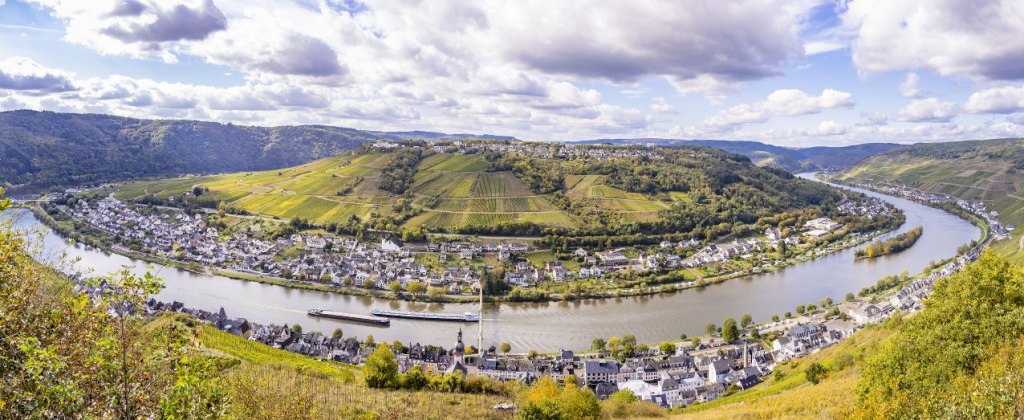
Zell an der Mosel is the wine town of the black cat: a small, old town on the Middle Moselle in Germany, known for its Zeller Schwarze Katz wine, for the Zeller Hamm – a loop of the river almost 14 kilometres long – and for one of the valley’s first big wine festivals each summer. This guide covers the best things to do in Zell, the viewpoints worth the climb, walking and cycling, getting there by train, and which neighbouring villages deserve a detour.
Three experiences we recommend
A wine tasting in the next village, a wagon ride through the vines and a classic Moselle river cruise – all highly rated by previous travellers.
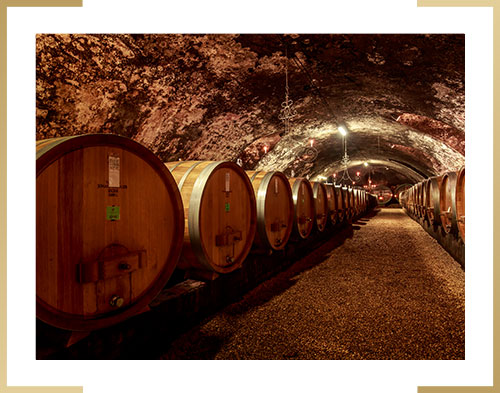 Reil: organic wine tasting and cellar tour
A guided tasting at an organic estate in Reil, the village just upstream of Zell – a good way to get to know the wines before you choose which bottles to take home.
Check prices & dates →
Often sells out
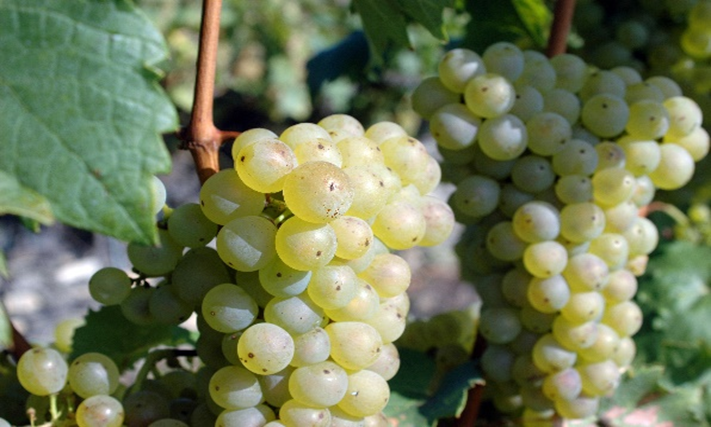 Kröv: covered wagon ride through the vineyards with tasting
A covered wagon climbs into the vineyards above Kröv, with tastings along the way. Relaxed and sociable – ideal for a group of friends.
Check prices & dates →
Top pick
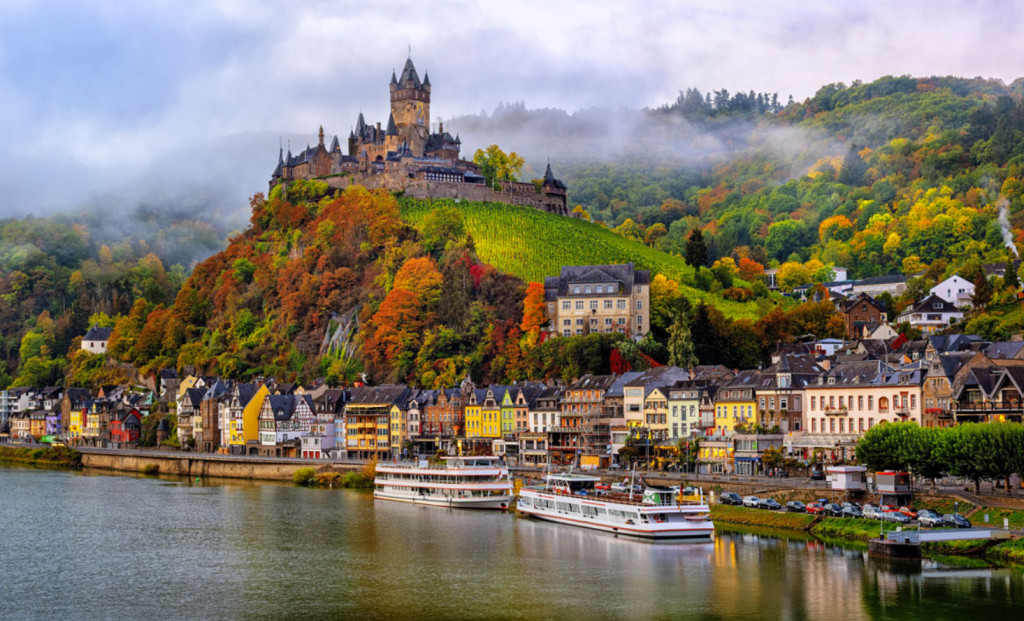 Cochem–Beilstein river cruise through the lock
An easy day out from Zell: train to Cochem, then a boat through the lock to the tiny village of Beilstein and back.
Check prices & dates →
Zell an der Mosel – not to be confused with Zell am See
First, a point that trips up a lot of people: there are several places called Zell. This guide is about Zell (Mosel), also known as Zell an der Mosel, in the state of Rhineland-Palatinate in western Germany. It is not the Austrian ski resort of Zell am See, nor Zell am Ziller in the Tyrol. There are no Alps and no lake here – instead you get steep vineyards, slate-roofed houses and one of the most dramatic bends anywhere on the Moselle.
Zell lies between Cochem and Traben-Trarbach, roughly an hour’s drive from both Koblenz and Trier. The town is made up of the old centre on the right bank plus the districts of Kaimt (across the river), Merl (downstream), Barl up on the hill and little Althaus. Zell was granted town rights back in the 13th century and spent centuries under the Electors of Trier, but major fires in 1848 and 1857 destroyed much of the old town. What survives of the Middle Ages is mainly its towers.
Things to see in the old town
- Runder Turm – the round tower is the town’s emblem, about 14 metres high and 6 metres across. It was part of the town walls and is also called the Pulverturm (powder tower), as gunpowder was once stored here. Its curved cap was added around 1690.
- Viereckiger Turm – together with the Runder Turm, the square tower is what was left of the fortifications after the fire of 1848.
- Schloss Zell – the Electors’ palace on the riverbank, a late-medieval building with two wings and corner towers dating from the mid-16th century.
- The riverside promenade and footbridge – the promenade is the town’s living room, and the narrow footbridge across the river gives a lovely view of the houses and vineyards.
- Collis-Turm – a small red-brick lookout tower from 1906, high above the vineyards. It is barely eight metres tall but has a sweeping view over Zell and the valley.
Walk up to the Collis-Turm at a weekend between May and October. There is usually a refreshment stand by the tower on Saturdays and Sundays from 11am to 5pm – if the blue flag is flying, it’s open.
Zeller Schwarze Katz – the wine and the legend of the black cat
Nobody visits Zell without meeting the cat. It sits on the fountain in the market square, in the town logo and on countless wine labels. Zeller Schwarze Katz (“Zell Black Cat”) is the name of the wine from Zell and the surrounding area, today a collective vineyard site (Großlage) covering the wines grown here. The traditional grape is Riesling – our guide to Moselle Riesling explains what makes it special.
The legend comes in several versions, and nobody knows for certain how the name arose. The best-known one is set in the 19th century. A few wine merchants from Aachen were working their way through Zell’s cellars in search of the best wine. At one grower’s they simply couldn’t choose between three barrels. Then the household’s black cat came down into the cellar, jumped onto one of the barrels, arched its back and hissed at anyone who came close. The merchants took it as a sign and bought the wine in that barrel. It sold so well that they came back and bought the whole vintage – and the wine became known as “Zeller Schwarze Katz”.
The Black Cat Fountain in the market square
The Schwarze-Katz-Brunnen stands on the Marktplatz in the old town, a few steps from the riverside promenade. It was put up in 1936 and is carved from Eifel basalt. The dialect inscription “He steiht ferm wie’n Zeller us’m Hamm” (roughly “he stands firm, like a Zell man from the Hamm”) refers to 1522, when around a hundred men from Zell hurried to Trier to help defend the city against the knight Franz von Sickingen. The fountain is the gathering point for the town’s festivals and the obvious spot for a photo.
“Schwarze Katz” on a label tells you more about where a wine comes from than how good it is, and quality varies a great deal between producers. If you want the best, taste at the local growers and their wine shops rather than grabbing the first bottle you see in a souvenir shop.
The Zeller Schwarze Katz wine festival
The Weinfest der Zeller Schwarzen Katz is usually held on the last weekend of June, from Friday to Monday, and is seen as the curtain-raiser for the season of big wine festivals along the Moselle. It takes place around the Marktplatz in the old town and along the riverside promenade, with wine from local growers, live music, food stalls and a small funfair.
In 2026 the festival ran from 26 to 29 June. It opened on the Friday with a parade of the town’s clubs and associations and the crowning of the new Wine Queen. Saturday brought the “Goldene Genüsse” tasting, Sunday was given over to performers and acrobats, and Monday rounded things off. According to the Zeller Land events calendar, the next festival is on 25–28 June 2027. The programme will be published nearer the time, so check the details on the town’s website before you book. Merl also holds its own wine festival. For more festivals along the river, see our overview of Moselle wine festivals.
Accommodation in Zell itself fills up early for the festival weekend. Consider staying in a nearby village on the railway line or bus route, or book well ahead. For help choosing your dates, read our guide to the best time to visit the Moselle Valley.
Zeller Hamm: the Moselle’s great loop and the best viewpoints
Below Zell the Moselle swings round in a loop almost 14 kilometres long known as the Zeller Hamm. At its neck, between Pünderich and Alf, the strip of land is less than 300 metres wide. The Marienburg sits up on that ridge, and it is from here that you see the loop at its best.
Prinzenkopfturm
The steel lookout tower on the Prinzenkopf is 22 metres high; the current tower opened in 2009. From the top you can see the valley from Reil to the Bremmer Calmont, the whole of the Zeller Hamm, the Hunsrück hills and the Kondelwald forest. The name goes back to a visit in 1818, when the Crown Prince of Prussia – later King Frederick William IV – climbed up to the rock and praised the view. The first tower, made of wood, was built soon afterwards. It’s about a ten-minute walk from the Marienburg.
Marienburg
The Marienburg was founded as an Augustinian convent in 1146, turned into a fortress in the 16th century and later remodelled in Baroque style. Today it is a youth and conference centre, so you can only see the building from outside. The view over the wine villages of Alf, Bullay, Merl, Briedel, Pünderich and St. Aldegund is reason enough to come, though, and there is a large car park.
Kaimt and Merl – Zell’s riverside districts
Kaimt faces the old town and is an easy stroll across the footbridge. First recorded as early as the 8th century, it became part of the town in 1950. From here you get the classic view of Zell’s church spires and rows of houses, and the town’s campsite lines the riverbank. Merl, which joined in 1969, lies downstream towards Bullay. It’s a quiet wine village with the church of St Michael, a former convent church. The Moselsteig trail passes through Merl and climbs on to the Merler Königshütte viewpoint. The riverside walk between Zell and Merl is flat and easy.
Walking and cycling around Zell
Moselsteig: stages 14 and 15
The Moselsteig long-distance trail runs right through Zell, and two stages work particularly well from here:
- Stage 14, Reil–Zell: approx. 12.4 km, around 3.5 hours, roughly 300 metres of ascent, graded easy. The trail passes viewpoints such as the Reiler Hals, the Drieschhütte, the Prinzenkopfturm and the Marienburg, and finishes at the Black Cat Fountain in Zell. Starting at Reil station makes it easy to take the train out and walk back.
- Stage 15, Zell–Neef: just under 20 km, around 6 hours and noticeably tougher. It runs via Merl and the Bullayer Königshütte to the wine village of Neef.
Moselle Cycle Route (Mosel-Radweg)
The Mosel-Radweg follows the river through Zell and is flat for most of its length, which makes it easy to split into day stages to Bullay, Pünderich or Traben-Trarbach. Local buses don’t carry bikes, but on some stretches of the Moselle you can book a place on a dedicated bike bus (radbusse.de). Our Moselle cycle route guide gives a good overview of the stages.
How to get to Zell: train via Bullay, bus and car
Zell has no station on the main line. The nearest is Bullay, a few kilometres downstream on the Koblenz–Trier line, where regional trains stop roughly every hour. From Bullay the little Moselweinbahn also runs to Traben-Trarbach, stopping at Reil among other places. Between Bullay and Zell, take the bus to the Lindenplatz stop, which is centrally placed by the footbridge. You buy your ticket from the driver, and timetables are on vrminfo.de. It’s a few kilometres, so most people take the bus or a taxi and only walk one way if they fancy following the river via Merl.
Travelling from further afield, most visitors fly into Frankfurt or Luxembourg. From either, you can continue by rail to Koblenz or Trier and change onto a regional train to Bullay, or hire a car and drive.
The double-decker bridge at Bullay
Arrive by train and you’ll cross one of the Moselle’s most unusual bridges. The Doppelstockbrücke between Alf and Bullay was Germany’s first double-deck bridge, with the railway on the upper deck and the road underneath. It is 314 metres long and was built in the 1870s as part of the Kanonenbahn (“Cannon Railway”), the strategic line between Berlin and Metz. Destroyed in an air raid in 1945, it reopened in April 1947. It’s worth a look from the riverbank in Alf or Bullay.
By car, there is free parking on the streets Brandenburg and Am Bahnhof near the footbridge. The closest airport is Frankfurt-Hahn in the Hunsrück, but most international visitors arrive via Frankfurt or Luxembourg. If you’re touring in a motorhome, see our guide to the Moselle by motorhome.
Nearby villages: Reil, Pünderich, Kröv and Traben-Trarbach
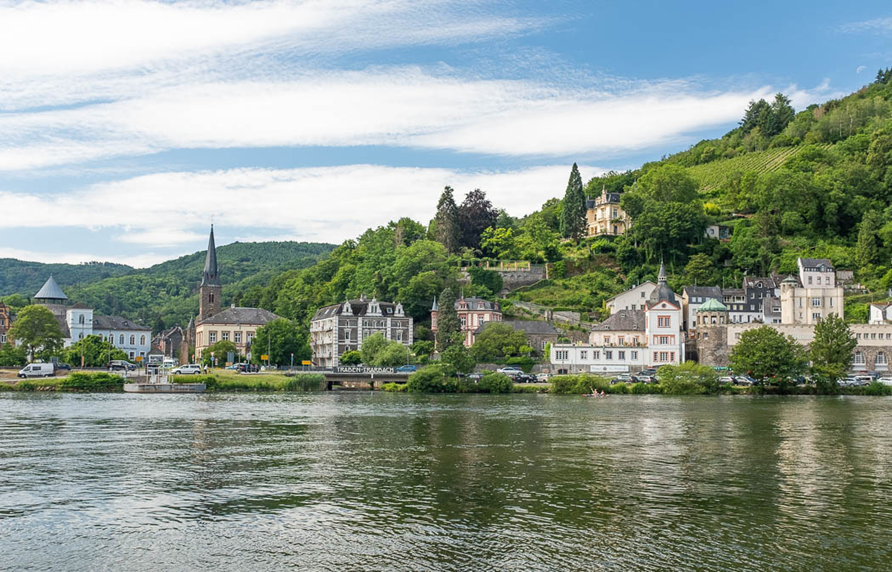
Zell makes a good base for exploring this stretch of the Moselle. Upstream lie the wine village of Reil and half-timbered Pünderich, both easy to reach by bike or on the Moselsteig. Further on is Traben-Trarbach, known for its Art Nouveau buildings; the easiest way there is the Moselweinbahn from Bullay. Beyond Traben-Trarbach lies Kröv, where winegrowers drive their guests up into the vineyards in covered wagons. If you want to venture further, Bernkastel-Kues is an obvious day trip.
Boat trips from Zell and a day trip to Cochem
During the season, passenger boats serve stops including Traben-Trarbach, Zell, Bullay, Beilstein and Cochem. Personenschifffahrt Gebr. Kolb is one of the operators on this stretch. Timetables and seasons vary, so check current sailings locally or at the tourist office. A popular plan is to take the train from Bullay to Cochem, see the town and castle, and then take the boat through the lock to Beilstein (approx. 2.5 hours return). For longer journeys on the river, see our guide to Moselle river cruises.
Where to stay in Zell
- Hotel Ratskeller, Balduinstraße 36 – a small hotel with a restaurant on the pedestrian street in the old town, a few steps from the Black Cat Fountain and the boat landings. It has 12 double and 2 single rooms. Check opening periods on the hotel’s website before you travel.
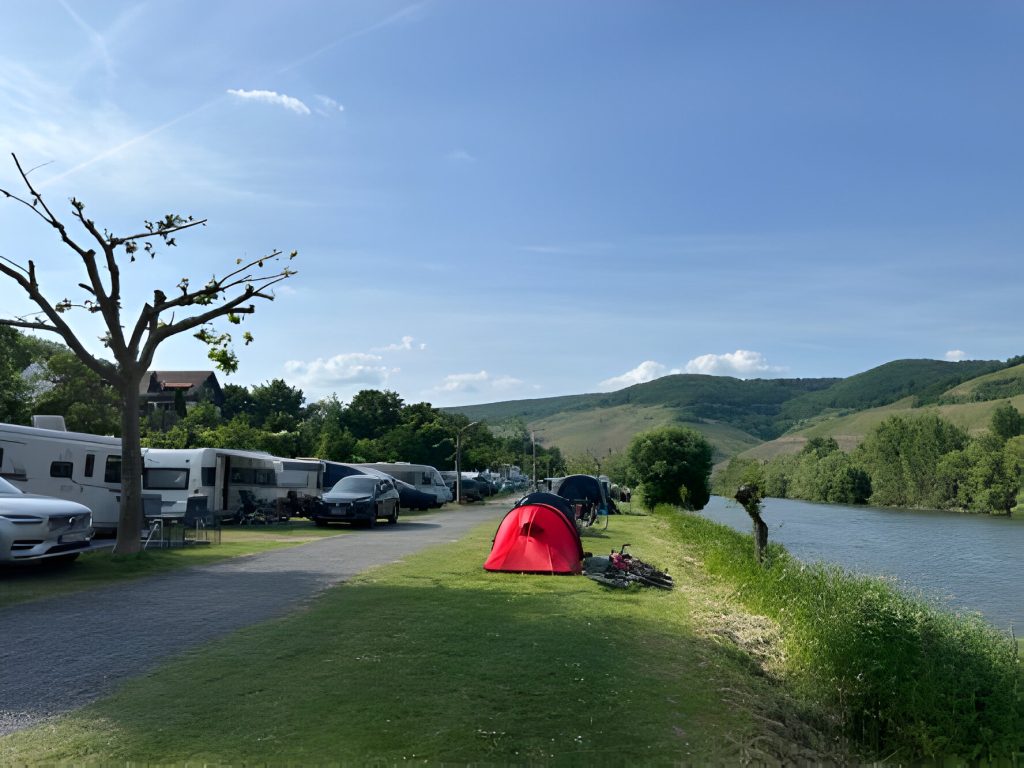
- Campingpark Zell-Mosel, Mosel-Hamm-Ufer 30 in Kaimt – a four-star campsite right on the river, with pitches for tents and motorhomes. The 2026 season began on 27 March. From 2 November 2026 to 19 March 2027 it operates as a motorhome stopover at winter rates, with no booking needed. For more options, see our guide to Moselle campsites.
- Wine estates and holiday flats – many winegrowers in Zell and the surrounding villages let rooms and apartments. The Zeller Land tourist office (Balduinstraße 44) has an accommodation search. You might also enjoy our article on how to stay at a winery on the Moselle.
Zell (Mosel) FAQs
Is Zell (Mosel) the same as Zell am See?
No. Zell (Mosel) is a wine town in Rhineland-Palatinate, Germany. Zell am See is a ski and lakeside resort in the Austrian state of Salzburg. They are several hundred kilometres apart and have nothing to do with each other.
How do you get to Zell without a car?
Take the train to Bullay on the Koblenz–Trier line, then the bus to the Lindenplatz stop in Zell. You buy your ticket from the driver; timetables are on vrminfo.de.
When is the Zeller Schwarze Katz wine festival?
It is usually held on the last weekend of June, from Friday to Monday. The next one is scheduled for 25–28 June 2027, according to Zeller Land. Check the programme on the town’s website closer to the date.
Where is the best view of the Zeller Hamm?
From the Prinzenkopfturm, a 22-metre lookout tower about ten minutes’ walk from the Marienburg. From the top you can see the whole loop, almost 14 kilometres long. The Collis-Turm above Zell offers a closer view of the town itself.
How many days do you need in Zell?
One day is enough for the old town, the fountain and a walk along the river. With two or three nights you’ll also have time to walk a stage of the Moselsteig, join a wine tasting and take a day trip to Cochem or Traben-Trarbach.
Can you go wine tasting in Zell?
Yes. Many growers have their own tasting rooms, and in neighbouring Reil there’s a guided tasting with a cellar tour at an organic estate that you can book in advance.
- Zeller Land Tourismus – Weinfest der Zeller Schwarzen Katz – 2027 dates, venue, last-weekend-of-June tradition
- Town of Zell (Mosel) – Weinfest – 2026 programme and dates
- Zeller Land Tourismus – Black Cat Fountain – 1936, basalt, inscription and 1522
- KuLaDig (LVR) – Zeller Schwarze Katz – the legend of the cat
- Zeller Land Tourismus – Runder Turm – dimensions and history
- Zeller Land Tourismus – Collis-Turm – date, height and refreshment stand
- Zeller Land Tourismus – Prinzenkopfturm – height, view, Zeller Hamm approx. 14 km, history
- Zeller Land Tourismus – Marienburg – history, current use, neck of the loop
- Zeller Land Tourismus – Lindenplatz bus stop – bus to Bullay, tickets, bikes
- Moselsteig stage 14 Reil–Zell (Bernkastel-Kues tourism) – distance, time, ascent, highlights
- ich-geh-wandern.de – Moselsteig stage 15 Zell–Neef – distance and time (supporting source)
- KuLaDig (LVR) – Doppelstockbrücke Alf-Bullay – construction, length, Kanonenbahn Berlin–Metz, reopening in 1947
- Wikivoyage – Zell (Mosel) – train via Bullay, boat operator, accommodation (supporting source)
- Wikipedia – Zell (Mosel) – districts and history (supporting source)
- Campingpark Zell-Mosel – address, 2026 season, winter arrangement
- Hotel Ratskeller Zell – address, location and number of rooms
Last updated: October 2026. Facts checked against the sources above; prices and opening hours may change.