
Things to Do in the Moselle Valley: 20 Best Ideas
This article contains affiliate links to GetYourGuide. If you book through them we may earn a small commission, at no extra cost to you.

Looking for things to do in the Moselle Valley? There is more than you can fit into a week: fairytale castles such as Burg Eltz, half-timbered villages like Beilstein and Bernkastel-Kues, Roman Trier, Europe’s steepest vineyard and boat trips between the wine villages. Here are our 20 best ideas, grouped by theme with practical advice, plus ready-made itineraries for 1, 3 and 5 days.
Three experiences we recommend
A boat trip, a wine walk through Trier and a wagon ride through the vineyards: three great ways to experience the valley.
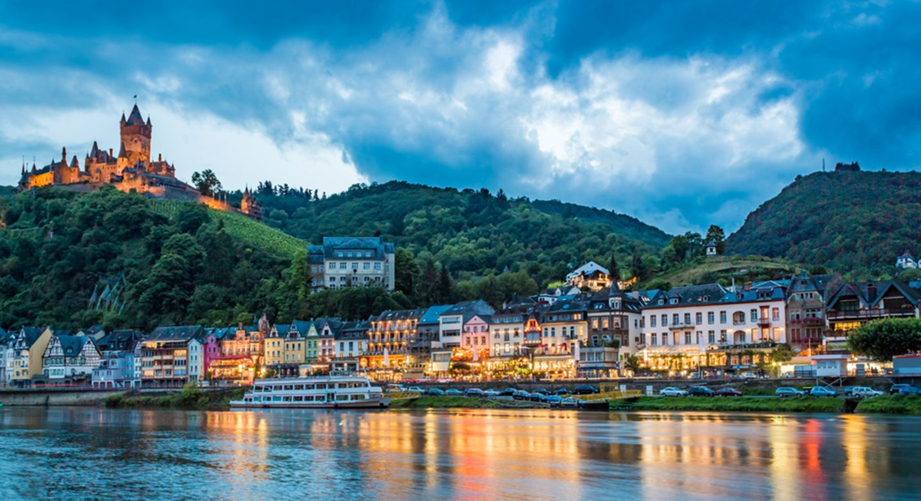 Cochem–Beilstein boat trip through a lock
The classic stretch past the vineyards to Beilstein, through one of the Moselle’s locks and back to Cochem.
Check prices & dates →
Most booked
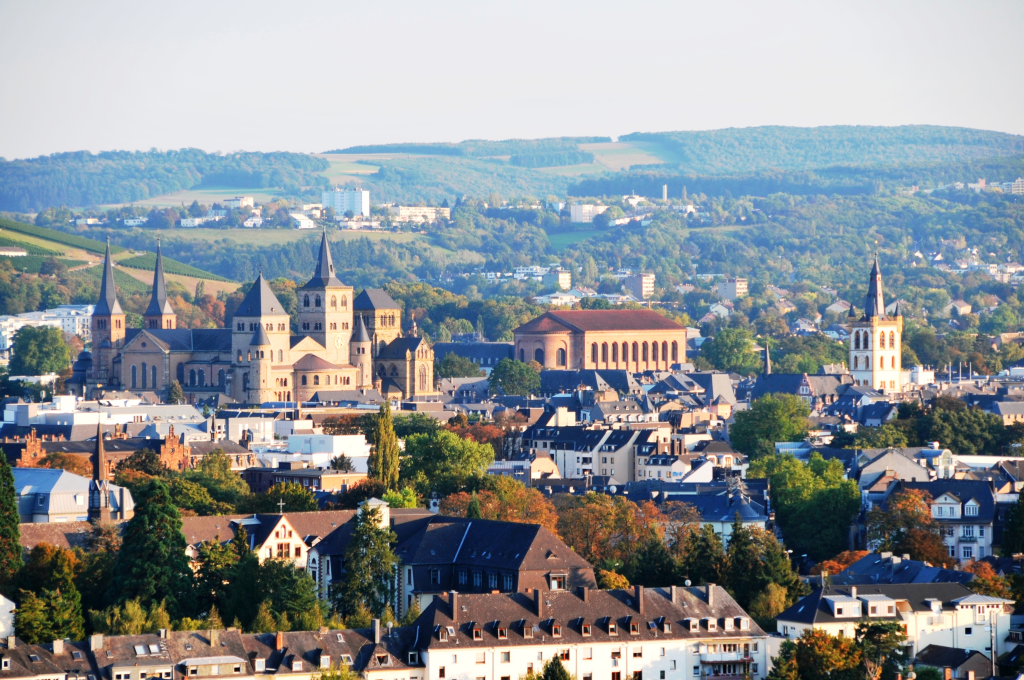 Trier: walking tour with wine tasting
Roman Trier on foot with a guide, with Mosel wines to taste along the way.
Check prices & dates →
Often sells out
 Kröv: vineyard wagon ride with wine tasting
A covered wagon through the vineyards above Kröv, with a winemaker who tells the stories and pours the wine. Nobody has to drive.
Check prices & dates →
The Moselle winds through Germany from the border country around Perl, where France, Luxembourg and Germany meet, to Koblenz, where it flows into the Rhine. Most of what you will want to see lies along the middle and lower stretches between Koblenz and Trier, and the distances are short: from Cochem you can reach Burg Eltz, Beilstein and the Calmont in under an hour. That is why we have grouped this list by theme rather than by geography. Pick what appeals, then piece your days together with our map of the Moselle Valley.
Castles in the Moselle Valley
1. Burg Eltz – the fairytale castle in the forest
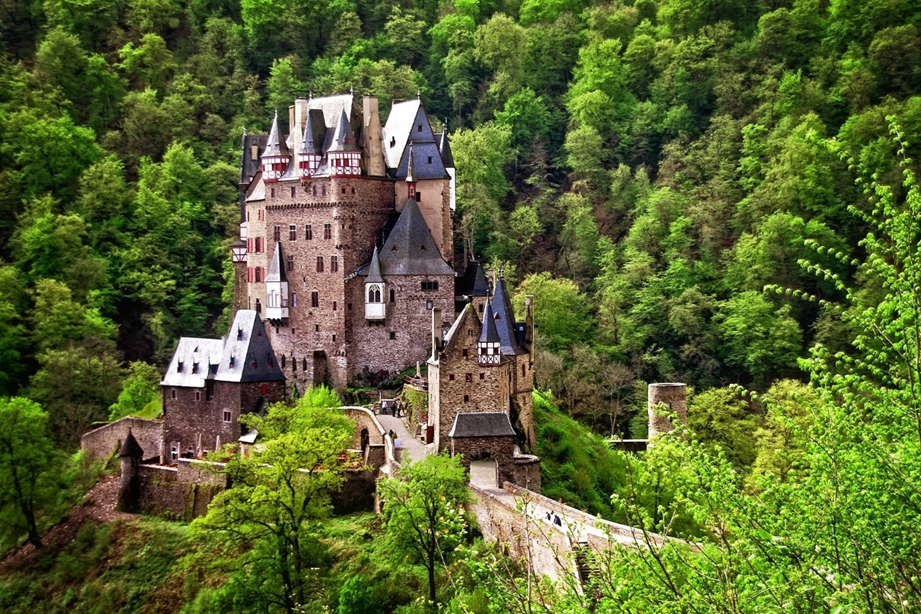
Why go: Burg Eltz clambers up a rock in the middle of a wooded side valley of the Moselle, with towers, oriel windows and slate roofs pointing in every direction. The same family has lived here for almost 900 years, and the castle came through the wars without being destroyed. The guided tour takes 35–40 minutes, and your ticket includes the treasury with its goldsmiths’ work and weaponry.
Need to know: the 2026 season runs from 29 March to 1 November, and the castle is open daily from 9.30am to 5pm. An adult ticket costs around €14. Drive to the car park at Wierschem (approx. €4, cash only), then walk down in 10–15 minutes or take the shuttle bus for about €2 each way, also cash only. If you would rather walk the whole way, a lovely path starts at Moselkern/Ringelsteiner Mühle: about 2.5 km and 35–45 minutes through the valley.
Arrive at opening time or late in the afternoon. In the middle of the day, at weekends and during the German school holidays, you may have to queue for a tour. Bring cash for the car park and the shuttle bus.
2. Reichsburg Cochem – the postcard castle above the town
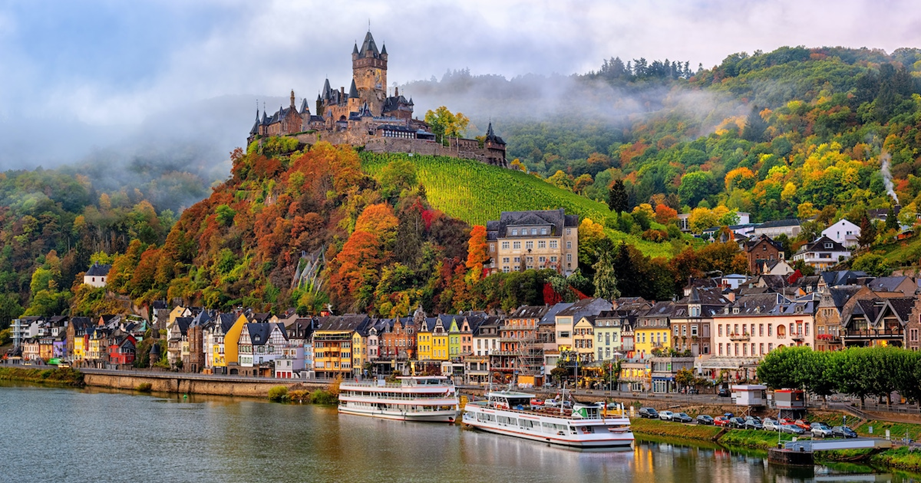
Why go: this is the castle you see in every other photo of the Moselle. A first castle here is recorded in 1130. French troops blew it up in 1689, and what you see today is a neo-Gothic reconstruction commissioned by the Berlin merchant Louis Ravené between 1868 and 1877. The interiors are lavish 19th-century Romanticism, and the view over Cochem from the terraces is every bit as good as the castle itself.
Need to know: the castle can only be visited on a guided tour of about 40 minutes. Adults pay around €10 (2026). In the summer season, from 14 March to 1 November, tours run from 9.30am to 5pm. Winter hours are shorter (usually 10am–3pm), and some periods are limited to a few days a week. There is no parking at the castle, so walk up from the old town (steep but short) or take the shuttle bus. There is more about the town in our guide to Cochem.
3. Burg Thurant – the double castle at Alken
Why go: one of the oldest and best-preserved hilltop castles on the Moselle, dating back to the 12th century and divided into two halves. You wander around on your own among walls and towers, with views from the ramparts over the vineyards above Alken. Much quieter than Eltz or Cochem.
Need to know: admission is around €5. The castle usually opens from early March to mid-November, with shorter days in spring and autumn. Check current times at thurant.de. Alken lies on the lower Moselle between Koblenz and Cochem and makes a good stop on the way.
4. Marksburg – a detour to the Rhine
Why go: if you are staying in Koblenz or on the lower Moselle, the Marksburg above Braubach is a short trip south along the Rhine. It is the only hilltop castle in the Middle Rhine Valley never to have been destroyed, so this is a genuine medieval castle rather than a 19th-century rebuild. It pairs well with Koblenz (number 11).
Wine villages and towns to visit along the Moselle
5. Cochem – riverside promenade, chairlift and wine taverns
Why go: Cochem is the liveliest small town on the lower Moselle: lanes of half-timbered houses, a long quay lined with boats and wine taverns at every turn. The chairlift up to the Pinnerkreuz viewpoint lifts you about 150 metres in a few minutes and gives the best view of the castle and the river.
Need to know: Cochem has a station on the Koblenz–Trier line and works well as a car-free base. Day-trippers arrive by boat and coach around lunchtime, so an evening stroll along the quay is often the nicest time. Read more in our Cochem guide.
6. Beilstein – the Sleeping Beauty of the Moselle
Why go: Beilstein is nicknamed “Dornröschen der Mosel” (the Moselle’s Sleeping Beauty) and has only around 130 residents. The village is a tight cluster of lanes, steps and wine cellars below the ruins of Burg Metternich, destroyed by the French in 1689. Further up the hill stands the Baroque Carmelite church. The village has been a film set since the 1930s, including for Der Schinderhannes (1958).
Need to know: the easiest way to get here is by boat from Cochem (see number 18). Keen walkers can instead hike stage 18 of the Moselsteig between Beilstein and Cochem (approx. 14 km) and take the boat back.
7. Bernkastel-Kues – the market square, the Spitzhäuschen and the Doctor vineyard
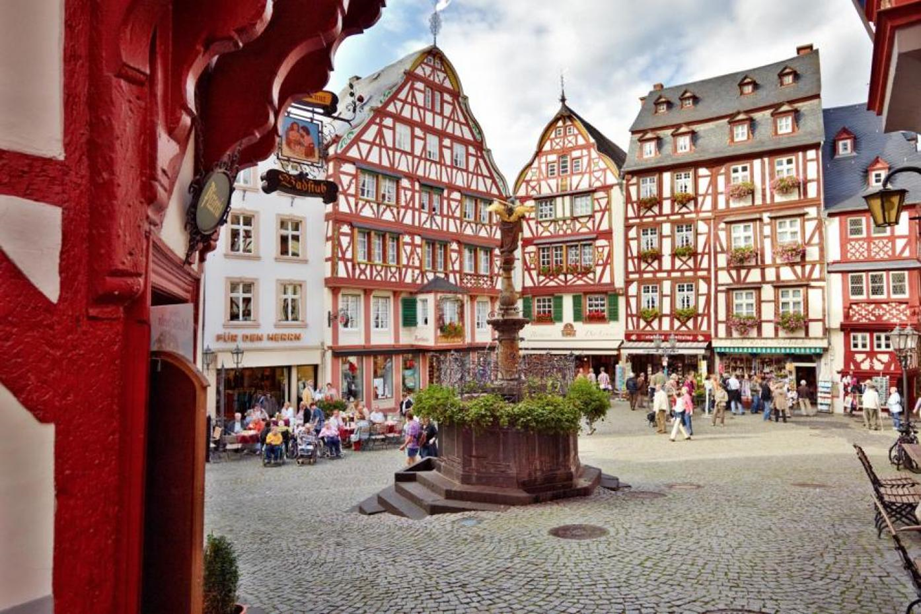
Why go: the jewel of the middle Moselle. Bernkastel’s market square is lined with gabled houses from the 15th to 17th centuries, with the Michaelsbrunnen fountain of 1606 in the middle. The leaning Spitzhäuschen, built in 1416, looks as though it might topple over. Above the town are the ruins of Landshut castle with sweeping views, and on the slope below lies the famous Bernkasteler Doctor vineyard. Across the river in Kues is the Cusanusstift, the late-medieval foundation established by Nicholas of Cusa.
Need to know: walk up to Landshut in the morning and save the wine tasting for after lunch. You will find more tips in our guide to Bernkastel-Kues.
8. Traben-Trarbach – Art Nouveau, wine cellars and a ruined fortress
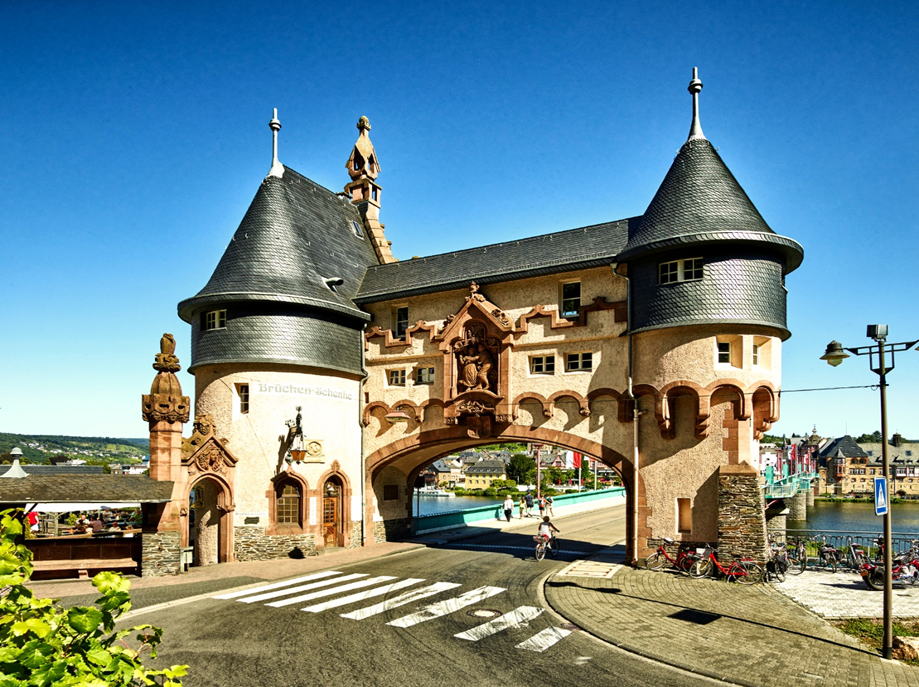
Why go: around 1900, Traben-Trarbach was one of the world’s biggest wine-trading centres, second only to Bordeaux according to the town itself. You can still see the money. The Berlin architect Bruno Möhring designed the Brückentor bridge gate (completed 1899), the Hotel Bellevue and the Julius Kayser wine cellars, where the Buddha Museum now displays more than 2,000 figures. Vast vaulted cellars run beneath the streets, and on the hill inside the river bend lie the remains of Mont Royal, the fortress Louis XIV had built between 1687 and 1698.
Need to know: it is a good rainy-day town, with a museum and cellar tours. Combine it with Bernkastel-Kues on the same day, as the two are close together along the river.
9. Zell and the view over the Zeller Hamm
Why go: Zell is home to the Zeller Schwarze Katz wine and has a relaxed riverside promenade. The main reason to come, though, is the Zeller Hamm, one of the tightest bends on the Moselle. You see it best from the Prinzenkopfturm lookout tower above Pünderich: 22 metres of steel, open around the clock, with views over the bend, the Marienburg and the villages of Reil, Alf, Bullay and Zell.
Need to know: park at the Marienburg and walk just over a kilometre to the tower. Read more in our guide to Zell.
10. Trier – Germany’s Roman capital
Why go: no other German city has so much Roman architecture within walking distance. The Porta Nigra city gate was built around AD 170 and is the best-preserved Roman city gate in Germany. Around it you will find the amphitheatre, the Imperial Baths (Kaiserthermen), the Basilica of Constantine, the cathedral and the Church of Our Lady (Liebfrauenkirche). Together they were inscribed as a World Heritage Site on 28 November 1986, so in 2026 Trier celebrates 40 years on the UNESCO list.
Need to know: allow a full day. Start at the Porta Nigra, where the tourist information centre is, and walk south through the Hauptmarkt to the cathedral and the Imperial Baths. If you fly into Luxembourg, Trier is the closest gateway to the valley. More in our guide to Trier.
11. Koblenz – Deutsches Eck and the cable car to Ehrenbreitstein
Why go: at the Deutsches Eck, the Moselle meets the Rhine. The cable car glides 890 metres across the Rhine and 112 metres up to the mighty Ehrenbreitstein Fortress, with views over both rivers. It opened in 2010, ahead of the BUGA 2011 federal garden show.
Need to know: Koblenz is a natural start or end point if you are arriving by train, for example from Frankfurt, or combining the Moselle with a trip along the Rhine. Read more in our guide to Koblenz.
Walking, cycling and nature in the Moselle Valley
12. Calmont Klettersteig – a via ferrata through Europe’s steepest vineyard
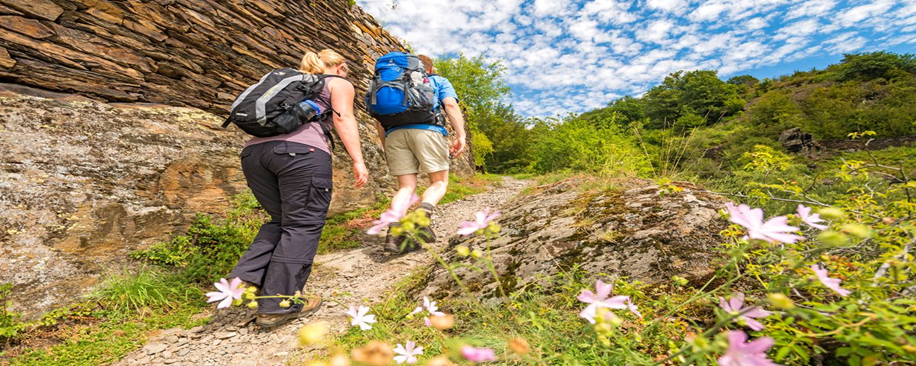
Why go: the Bremmer Calmont is regarded as Europe’s steepest vineyard, and a protected climbing path with ladders, cables and footholds cut into the rock runs through its plunging terraces between Ediger-Eller and Bremm. Below you lie the Bremm river bend and the ruins of Stuben convent. It is one of the most spectacular walks in Germany.
Need to know: the via ferrata section itself takes 1–2 hours. The circular route, returning over the top of the Calmont, is about 6 km and takes roughly 3 hours. It is not for anyone with a fear of heights. You need sturdy footwear and a sure foot, but no climbing gear. Start at Ediger-Eller railway station.
Calmont roughly means “hot mountain”. The south-facing slope gets baking hot, and local tourist offices advise against doing the route in the middle of the day when it is over 30°C. Go early in the morning or late in the afternoon, and take plenty of water.
13. Moselsteig – walk it stage by stage
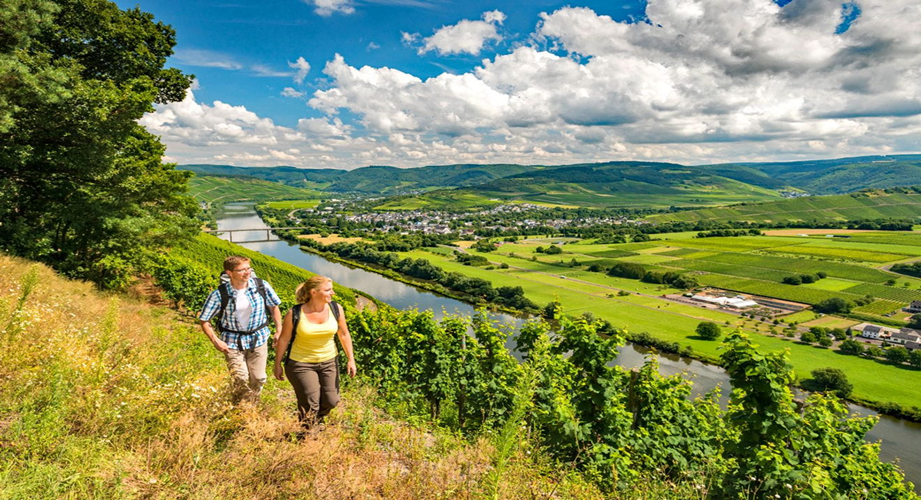
Why go: the Moselsteig runs for about 365 km in 24 stages, from Perl on the border with Luxembourg and France to the Deutsches Eck in Koblenz. It opened in 2014 and is certified as a quality trail. You do not have to walk the lot: most stages are 12–24 km long and end in a village with a train, bus or boat back.
Need to know: three good day stages are stage 16 Neef–Ediger-Eller (approx. 11 km) with views of the Calmont, stage 18 Beilstein–Cochem (approx. 14 km) and stage 20 Treis-Karden–Moselkern (approx. 14 km), which passes close to Burg Eltz. Spring and autumn are the best seasons. There is more on the weather in our guide to the best time to visit the Moselle.
14. Moselle Cycle Route – cycling along the river
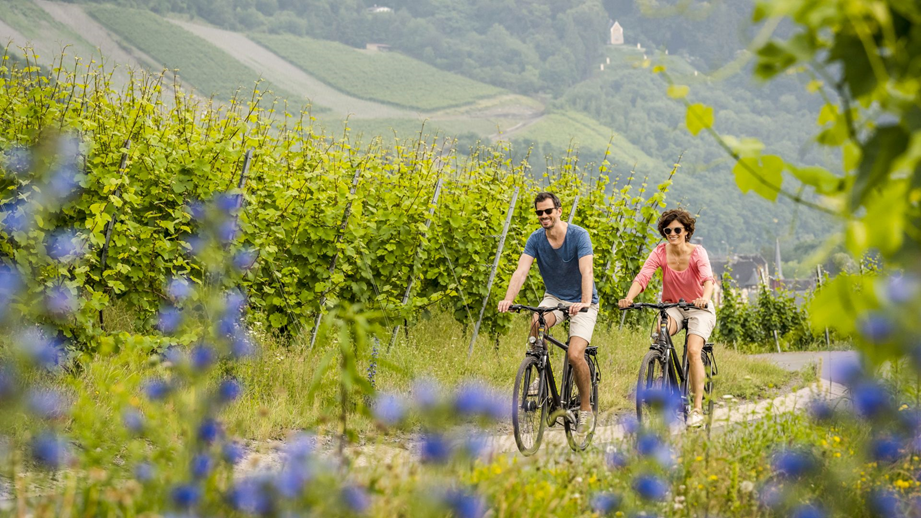
Why go: the German section of the Moselle Cycle Route (Mosel-Radweg) is about 248 km long, from Perl to Koblenz. It is almost entirely flat, well signposted and largely traffic-free. It is one of Germany’s most popular cycle routes and suits occasional cyclists too.
Need to know: cycle one way and take the train or boat back. Two good day rides are Bernkastel-Kues–Traben-Trarbach and Cochem–Treis-Karden. E-bikes can be hired in the larger towns. Routes and maps are on our Moselle cycle route page.
15. Geierlay – the suspension bridge in the Hunsrück
Why go: the Geierlay suspension bridge opened in 2015. It is 360 metres long and hangs up to about 100 metres above the Mörsdorfer Bachtal valley in the Hunsrück hills, south of the Moselle. It sways more than you might expect.
Need to know: it is free and open around the clock all year, except in storms and thunderstorms. Park at the visitor centre in Mörsdorf (charge) and walk about 1.8 km along a gravel track. Pushchairs are not allowed on the bridge, but dogs on a lead are fine. Arrive early at weekends, as the car park fills up.
Wine, wine taverns and boat trips on the Moselle
16. Wine tasting at a winery – or out in the vineyards
Why go: the Moselle is Riesling’s home ground, and the best way to understand the wines is to taste them where they are grown. Almost every village has winemakers with a Weinprobe (tasting) or Verkauf (sales) sign. It is worth phoning ahead, as many are family estates without fixed opening hours. If you would rather not drive, book a wagon ride or wine hike with transport and tasting included.
Need to know: learn the difference between trocken (dry), feinherb (off-dry) and Spätlese (late harvest) before you go, and the tasting will be much easier. Our guide to Riesling will help. To get really close to the wine, you can stay at a winery.
17. Weinstuben, Straußwirtschaften and wine festivals
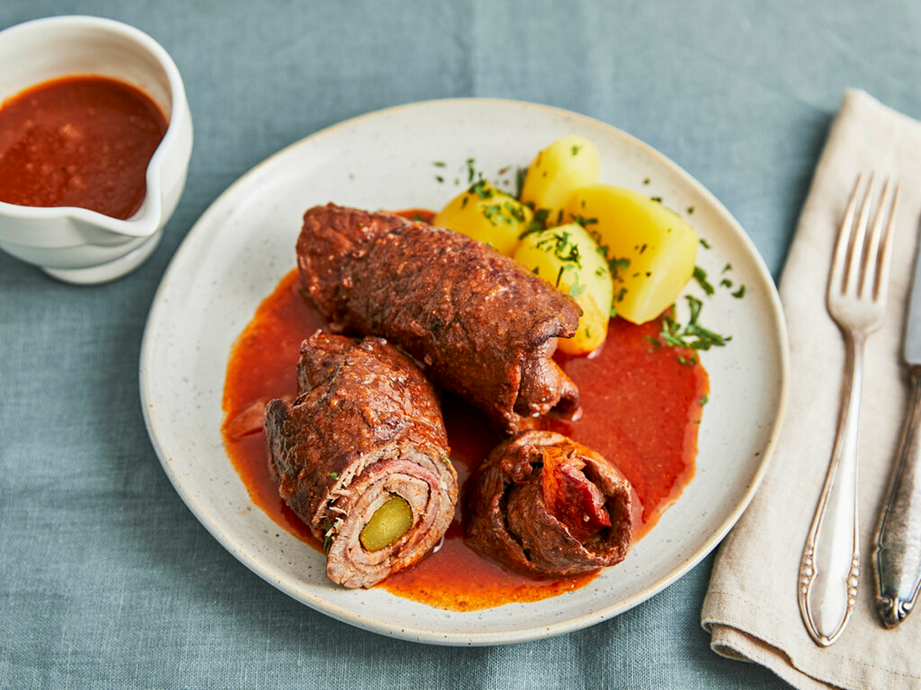
Why go: evenings on the Moselle are spent in a Weinstube, with wine by the glass and simple food such as Flammkuchen (a thin, crisp tart with crème fraîche, onions and bacon) or Rinderrouladen. Even more local are the Straußwirtschaften, pop-up wine taverns run by winemakers at home. They may only serve their own wine and open for no more than four months a year, often in spring and at harvest time. A broom or wreath hung by the gate means they are open.
Need to know: from late summer to October, almost every village holds its own wine festival. Dates and the biggest events are in our article on Moselle wine festivals.
The highest-rated wine experiences
Three small tours in the vineyards, all rated 4.7 or higher.
Pommern: wine hike with tasting
A short walk through the vineyards near Cochem, with a tasting at a viewpoint.
Check prices & dates →
Often sells out
Bernkastel-Kues: wagon ride with picnic
A rolling wine tasting with a picnic basket through the vineyards at Lieser and Bernkastel.
Check prices & dates →
Often sells out
Kröv: wagon ride with wine tasting
A covered wagon through the vineyards above Kröv, between Traben-Trarbach and Bernkastel.
Check prices & dates →
18. A boat trip on the Moselle
Why go: from the water you see the vineyards rising almost vertically out of the river, and the villages appear one after another in order. The most popular stretch is Cochem–Beilstein. It passes through a lock and takes a couple of hours there and back, and you can get off in Beilstein and catch a later boat home. There are also trips around the Marienburg, Bernkastel and Trier.
Need to know: several local operators, including Personenschifffahrt Kolb, run scheduled trips from spring to late autumn, with the most frequent departures from May to October. If you are thinking about a longer cruise, read our guide to a Moselle river cruise.
Quirky days out, winter tips and family fun
19. The Bundesbank Bunker in Cochem
Why go: during the Cold War, a secret bunker vault in Cochem-Cond held around 15 billion Deutschmarks in emergency currency. The notes were meant to replace the regular ones if the country was flooded with counterfeit money. Today the bunker is a museum (ten years old in 2026) and one of the valley’s most unexpected visits.
Need to know: tours last about 45 minutes and are held in German, but printed material and an app-based audio guide are available in other languages. It stays at around 12°C inside all year, so bring a jumper. There is no parking at the bunker; from May to October a shuttle bus leaves Endertplatz in Cochem before each tour. Tickets can be bought on site or online.
20. Christmas markets – including one underground in Traben-Trarbach
Why go: in December the whole valley lights up. The most original market is the Mosel-Wein-Nachts-Markt in Traben-Trarbach, held in the town’s historic underground wine cellars. It runs from 20 November 2026 to 2 January 2027, but only at weekends. Trier has a large Christmas market on the Hauptmarkt in front of the cathedral, and Bernkastel-Kues and Cochem usually hold markets during Advent too.
Need to know: Burg Eltz is closed in winter, but Reichsburg Cochem and the bunker run tours in December. Check the days in advance. There is more on the seasons in our guide to Moselle Valley weather.
Wild- und Freizeitpark Klotten lies just north-east of Cochem and mixes a wildlife park, birds-of-prey displays and rides such as a rapids ride and a dark ride. The 2026 season runs until 1 November, with the Halloween-themed “Klottiween” in October. Check opening times at klotti.de before you go. It makes a good break between castles and wine villages.
Itineraries: the Moselle Valley in 1, 3 or 5 days
If you only have 1 day
- Morning: Burg Eltz at opening time (9.30am).
- Afternoon: Cochem: a guided tour of the Reichsburg, then the chairlift up to the Pinnerkreuz.
- Evening: dinner and a glass of Riesling in a wine tavern on the quay.
If you have 3 days
- Day 1: Burg Eltz and Cochem, as above.
- Day 2: boat to Beilstein, then the Calmont Klettersteig or the view over the Zeller Hamm. Or the Bundesbank Bunker if it rains.
- Day 3: Traben-Trarbach in the morning, Bernkastel-Kues and a wine tasting or wagon ride in the afternoon.
If you have 5 days
- Days 1–3: as above.
- Day 4: Trier: Porta Nigra, the cathedral, the Imperial Baths and a wine walk in the evening.
- Day 5: Koblenz with the cable car and Ehrenbreitstein (plus Burg Thurant or Geierlay on the way), or a day trip from Trier to Luxembourg.
Travelling by motorhome or with a tent? Read our guides to the Moselle by motorhome and Moselle campsites. If you want to compare places before choosing a base, there is an overview of the towns of the Moselle Valley.
FAQ: things to do in the Moselle Valley
What are the best things to do in the Moselle Valley?
The classics are Burg Eltz, Reichsburg Cochem, a boat trip to Beilstein, a tasting at a winery and Roman Trier. If you like being active, the Calmont Klettersteig and a stage of the Moselsteig should be high on your list.
How many days do you need in the Moselle Valley?
Three days is enough for the castles, Cochem, Beilstein and Bernkastel-Kues. With five days you can also fit in Trier and Koblenz, or a full-day walk, without rushing.
How much does it cost to visit Burg Eltz?
In the 2026 season an adult ticket costs around €14, including the guided tour and the treasury. On top of that comes parking (approx. €4) and, if you use it, the shuttle bus (approx. €2 each way). Both are cash only.
What can you do in the Moselle Valley when it rains?
Reichsburg Cochem and the Bundesbank Bunker are indoors. Trier has museums and its cathedral, and Traben-Trarbach has the Buddha Museum and its wine cellars. A cellar wine tasting works in any weather.
Is the Moselle Valley worth visiting in winter?
Yes, especially in December for the Christmas markets, such as the underground one in Traben-Trarbach. Bear in mind that Burg Eltz and most boats take a break, while Reichsburg Cochem and the bunker run tours with shorter hours.
Where is the best place to stay in the Moselle Valley?
Cochem if you want castles and good train links. Bernkastel-Kues or Traben-Trarbach if wine is the main attraction. Trier if you want a city, culture and easy access to Luxembourg and its airport.
- Burg Eltz – official website – 2026 season, opening hours, parking, shuttle bus, footpath from Moselkern
- Burg Eltz – Öffnungszeiten & Tickets – 2026 ticket price, tour length, treasury
- Burg Eltz – Familie Eltz – the family has lived there for almost 900 years
- Reichsburg Cochem – Öffnungszeiten – summer and winter hours 2026, guided tours only
- Reichsburg Cochem – Preise – price and tour length
- Wikipedia: Reichsburg Cochem – history (1130, 1689, Ravené 1868–1877)
- Burg Thurant – location, double castle, opening hours, price
- Marksburg – the only hilltop castle in the Middle Rhine Valley never destroyed
- Wikipedia: Beilstein (Mosel) – nickname, Burg Metternich, Carmelite church, films, population
- Wikipedia: Bernkastel-Kues – Spitzhäuschen 1416, Michaelsbrunnen, Landshut, Doctor, Cusanusstift
- Town of Traben-Trarbach – Jugendstilarchitektur (PDF) – Bruno Möhring, history of the wine trade
- Wikipedia: Festung Mont Royal – built 1687–1698
- Mosel-Wein-Nachts-Markt Traben-Trarbach – 2026/27 dates, weekend opening, wine cellars
- Mosellandtouristik – Prinzenkopfturm – view over the Zeller Hamm, the tower
- Trier Tourismus – 40 Jahre Welterbe – UNESCO 28 November 1986, listed monuments
- Wikipedia: Porta Nigra – built around AD 170
- Seilbahn Koblenz and Wikipedia: Seilbahn Koblenz – length 890 m, height gain 112 m, opening
- VRM – Calmont-Klettersteig (PDF) – timings, 6 km/3 hr circuit, heat warning
- Wikipedia: Bremmer Calmont – Europe’s steepest vineyard
- VG Cochem – Wandern auf dem Moselsteig 2026 (PDF) – 365 km, 24 stages, stage lengths
- Mosellandtouristik – Factsheet Mosel 2024 – Mosel-Radweg 248 km Perl–Koblenz
- Hängeseilbrücke Geierlay and Wikipedia – 360 m, 100 m high, free, opened 2015, 1.8 km walk, rules
- Landwirtschaftskammer Rheinland-Pfalz (PDF) – rules for Straußwirtschaften (own wine, four months maximum)
- Personenschifffahrt Kolb – boat trips from Cochem
- Bundesbank-Bunker Cochem – 2026 tours, length, temperature, shuttle bus, 15 billion DM
- Wild- & Freizeitpark Klotten – 2026 season, Klottiween, rides
Last updated: October 2026. Facts checked against the sources above; prices and opening hours may change.