
Traben-Trarbach: a guide to Art Nouveau, wine cellars and Kröv
This article contains affiliate links to GetYourGuide. If you book through them we may earn a small commission, at no extra cost to you.
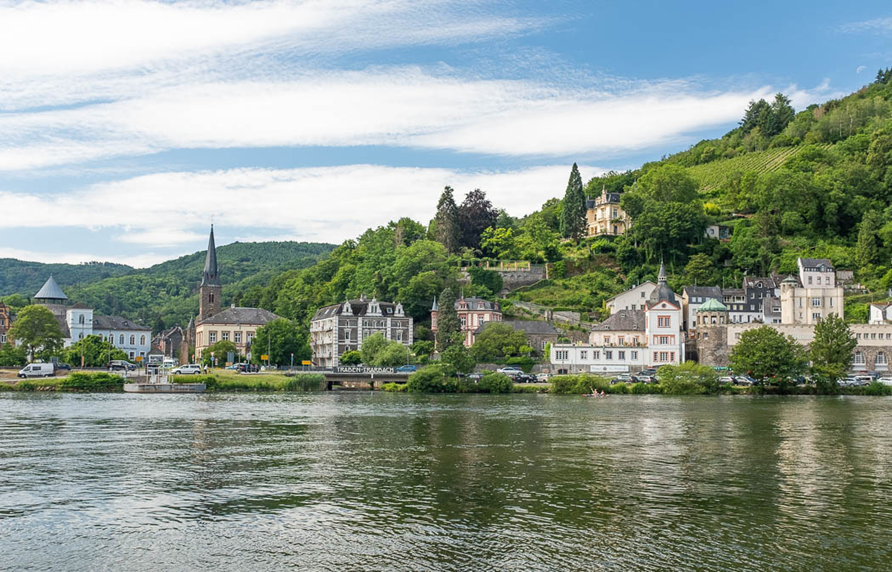
Traben-Trarbach is the Moselle’s Art Nouveau town: two old wine villages facing each other across the river that grew rich on the wine trade around 1900 and spent the money on villas, hotels and enormous cellars. This guide covers the best things to do in Traben-Trarbach – the Jugendstil architecture, the cellars beneath the streets, the ruins on the hills and the underground Christmas market – plus the neighbouring village of Kröv, with its Kröver Nacktarsch wine and covered-wagon rides through the vineyards. And how to get there by train, boat, bike or car, or as a stop on a river cruise.
Three experiences we recommend
Two covered-wagon rides with wine tasting in the vineyards above Kröv – both among the highest rated in the whole valley – and a short boat trip from Bernkastel, a little way upstream.
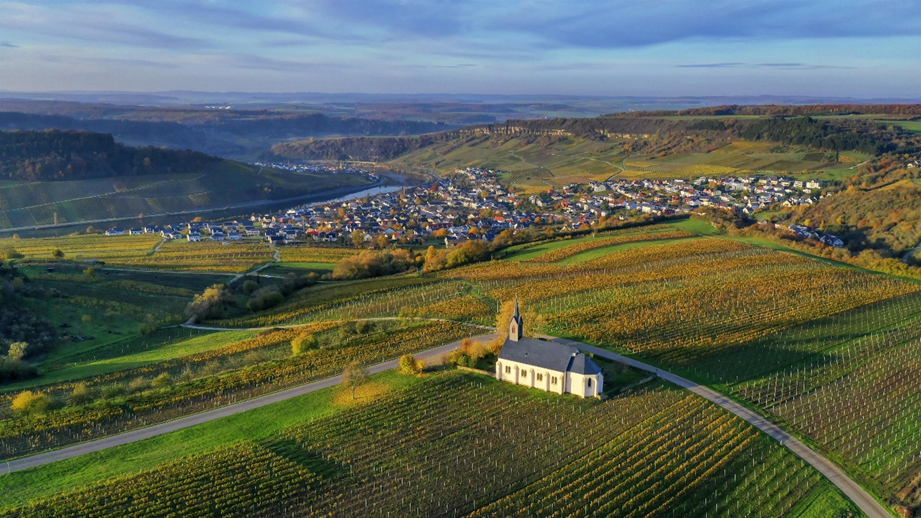 Kröv: covered wagon through the vineyards with wine tasting
A tractor-drawn wagon climbs up among the vines with a Kröv winegrowing family who tell the story and pour as you go. Nobody in your group has to drive.
Check prices & dates →
Top rated
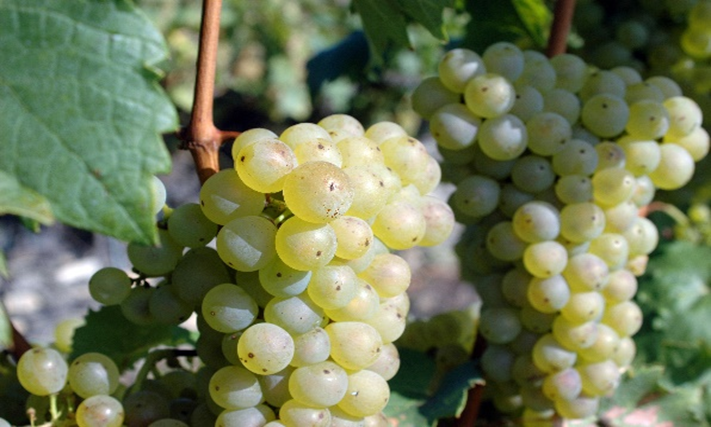 Kröv, Gut Hermes: panorama wagon ride with sparkling wine and tasting
The same idea with a focus on the views: the wagon takes you up to spots overlooking the Moselle’s loop, with a glass of sparkling wine and a tasting of the estate’s wines.
Check prices & dates →
Most booked
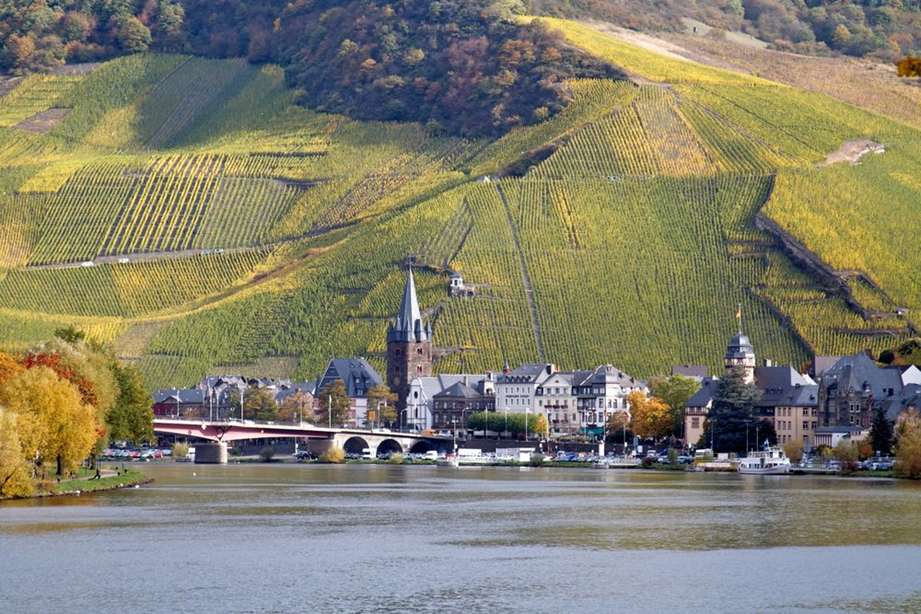 Bernkastel: 1-hour panoramic boat trip
An easy hour on the river from Bernkastel past Lieser and Mülheim – simple to combine with a day in Traben-Trarbach and Kröv.
Check prices & dates →
Traben-Trarbach – the Art Nouveau town built by the wine trade
What strikes most people on arrival in Traben-Trarbach is that it doesn’t look like a typical Moselle village. Instead of tight lanes of half-timbered houses, the riverfront is lined with turreted villas, tiled façades and sinuous wrought-iron railings. The explanation is wine. Around 1900, according to the town itself, Traben-Trarbach was Europe’s second-largest wine trading centre, after Bordeaux. More than a hundred wine merchants set up here, and the Protestant parish’s close ties with Prussia opened up lucrative export routes to neighbouring countries and on across the seas.
Traben and Trarbach sit on opposite banks of the Moselle and remained separate places until 1904. Trarbach had also been badly hit by the town fire of 1857, so when the wine money poured in there was both space and appetite to build anew. The result is an unusually complete Art Nouveau townscape – and, beneath the streets, a network of wine cellars you can go down into today.
The Brückentor and Bruno Möhring’s buildings
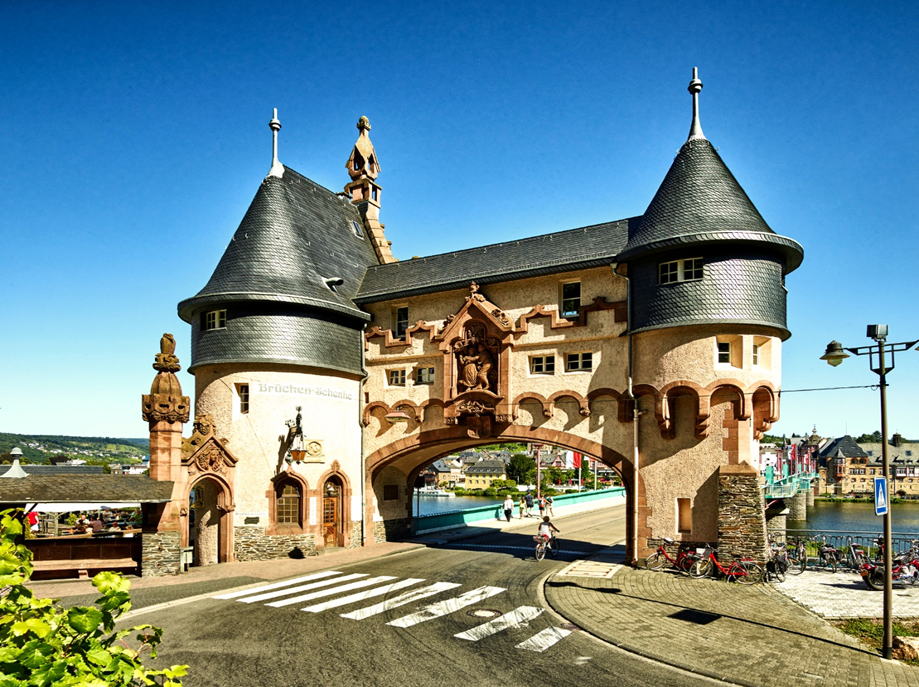
Joining the two towns needed a bridge, and the competition was won by the Berlin architect Bruno Möhring (1863–1929), one of the leading figures of Art Nouveau – Jugendstil, as it’s called in Germany. In 1898–1899 he built the first Moselle bridge between Trarbach and Traben, together with the turreted Brückentor (bridge gate) on the Trarbach side. The gate still stands at the end of the bridge and is the town’s emblem today. The mark of Möhring and his contemporaries is everywhere:
- Hotel Bellevue on the Traben riverfront – Möhring designed the façade, and the tower is shaped like a champagne bottle, with champagne glasses and golden bubbles in the decoration. The hotel describes itself as Germany’s only Art Nouveau hotel preserved in its original form.
- Villa Huesgen and Villa Nollen (formerly Villa Breucker) – two of the villas along the Moselufer in Traben that show how the wine merchants lived.
- Kellerei Julius Kayser in Trarbach – a wine merchant’s Art Nouveau winery by Möhring, now home to the Buddha Museum (see below).
- Stadthaus Alter Bahnhof in Traben and the commercial building at Brückenstraße 20 in Trarbach – less well known, but worth a detour on your walk.
If you’d like the story told, the town runs a guided wine-architecture walk, the Weinarchitektonischer Spaziergang. It runs May–October on the first and third Sunday of the month at 11am from the square in front of the tourist office, takes about 1 hour 45 minutes and ends down in one of the cellars. It costs around €15, less with the Mollie Guestcard visitor card, and a glass of sparkling wine is included.
The Unterwelt – the wine cellars beneath Traben-Trarbach
In the second half of the 19th century the wine cellars were extended so heavily that much of the town centre now sits on top of them. Some vaults run more than a hundred metres in beneath the houses. Since 2008 you’ve been able to visit the cellars with a guide, and the network the town calls the Unterwelt (“underworld”) now includes 32 cellars. Several still belong to wine estates – for example the old Dreigiebelhaus winery (now Weingut Louis Klein) and the former Böcking and Langguth wineries (Weingut Böcking).
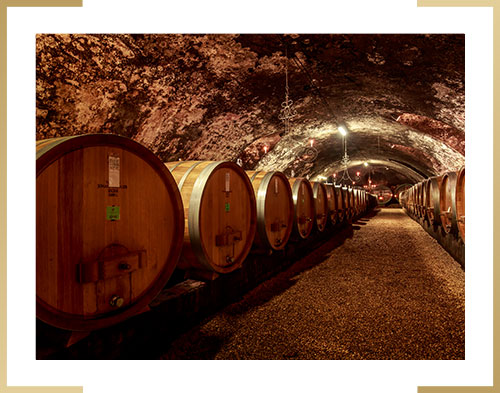
- Standard tour: about 1.5 hours, around €14 including a glass of wine (reductions for children aged 6–15 and with the Mollie Guestcard). From Easter to the end of July it runs on Fridays and Mondays at 5pm, from August to October on several days a week, and from November to Easter on the second and last Friday of the month at 5pm. During the Christmas market it runs on Saturdays at 11am.
- Premium tour: about 2.5–3 hours – a cellar tour followed by a tasting of four wines with nibbles at a wine estate. June–October, on the second and last Saturday of the month, ages 16 and over.
The cellars stay at around 12°C all year, so bring a jumper even on a hot July day. Dogs aren’t allowed. Tickets are sold through the town’s online ticket shop or at the tourist office by the station (Am Bahnhof 5).
To understand what’s ageing down there, our guide to Moselle Riesling is a good place to start – it’s the grape that paid for both the cellars and the villas.
Buddha Museum, Mittelmosel-Museum and Moseltherme
Traben-Trarbach is one of the best places in the valley for a rainy day, because so much of it is indoors – or underground.
The Buddha Museum in Julius Kayser’s Art Nouveau winery
It may sound an odd combination, but the Buddha Museum is one of the town’s big attractions. It occupies Möhring’s former Julius Kayser winery on Bruno-Möhring-Platz in Trarbach and displays Buddha figures, sculptures and images from many Asian countries across around 4,000 square metres, including a roof garden. The 2026 season runs from 31 March to 1 November, Tuesday–Sunday and on public holidays from 10am to 6pm (last admission 5pm). It’s closed on Mondays, and in previous winters the museum has closed from early January to the end of March.
The Mittelmosel-Museum in Haus Böcking
The town museum is in a Baroque villa that the merchant Johann Adolf Böcking had built around 1755 and which survived the fire of 1857. Goethe once stayed here as a guest. Inside you’ll find furniture and art from three centuries, Roman and Frankish finds, a model of the Grevenburg, and plans and finds from the excavations of the Mont Royal fortress – a good visit before you climb up to the ruins. From 1 April 2026 it’s open Tuesday–Friday 10am–5pm and Saturday–Sunday 12pm–4pm; adults pay around €5.
Moseltherme – the thermal baths at Bad Wildstein
At Bad Wildstein, home to the town’s thermal spring, you’ll find the Moseltherme thermal baths (Wildsteiner Weg 5). The indoor thermal pool is kept at 32°C and the outdoor pool at 31°C, and there’s a whirlpool, a lap pool, a children’s area and a sauna area with Finnish saunas, a steam bath and a salt sauna among others. The baths are normally open Tuesday–Friday 9am–9pm, at weekends 9am–6pm and on Mondays from 2pm, but close every year in weeks 3–5 and on some public holidays. Prices are on moseltherme.de.
Grevenburg and Mont Royal – the ruins above the town
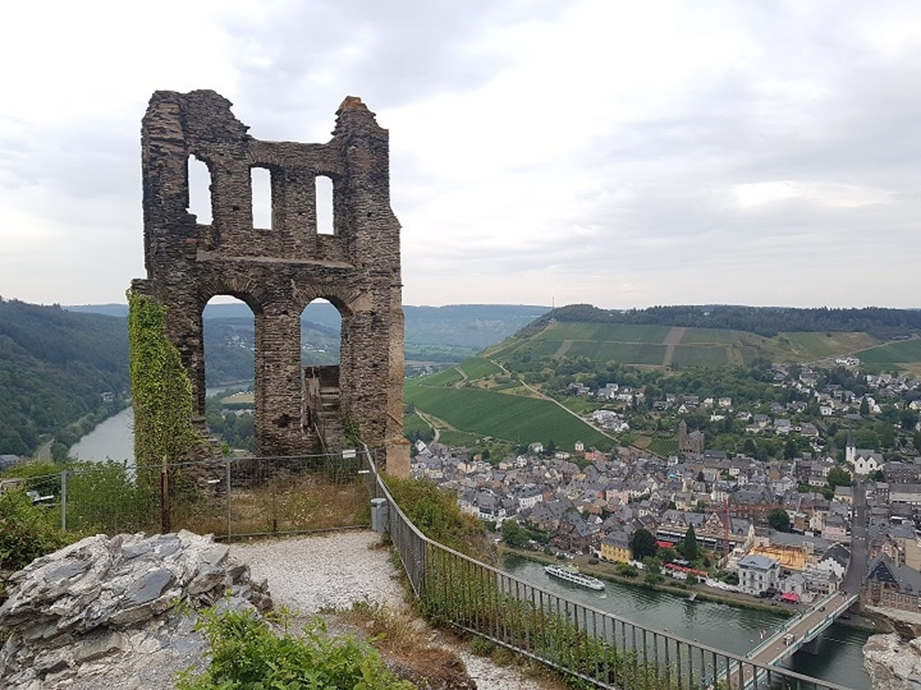
The Grevenburg is the distinctive ruined wall on the hill above Trarbach. The castle was built around 1350 by Count Johann III of Sponheim, son of the legendary Countess Loretta, and was the counts’ seat until 1437. During the wars of the 17th and 18th centuries it changed hands thirteen times before French troops took and destroyed it in 1734. Today the main draw is the view: from up here you can see the whole town, the bridge and the river. Expect a steep walk up.
Across the river, on the hill inside the Moselle’s loop high above Traben, are the remains of Mont Royal – one of the most ambitious fortress projects in the Rhineland. From 1687 Louis XIV had a fortress built here to plans by his engineer Vauban, designed for 12,000 soldiers and 3,000 horses. After the Peace of Rijswijk, the French demolished it themselves in 1698. What survives are fragments of wall, casemates and vaulted cellars. The town runs its own guided Entdecker-Tour (“explorer tour”), with torches, on the third Saturday of the month at 10.30am from May to October, and you can also explore on your own with a leaflet from the tourist office.
Mosel-Wein-Nachts-Markt – the underground Christmas market
During Advent, Traben-Trarbach moves down into its cellars. The Mosel-Wein-Nachts-Markt is held in the town’s historic wine cellars – some dating from the 16th century – and bills itself as the only underground Christmas market. The cellars aren’t connected, so you follow an illuminated trail through the town from one to the next, with wine, food and Christmas crafts along the way. The 2026/27 season runs from 20 November 2026 to 2 January 2027, but only at weekends.
- Admission: around €5 for adults, and the ticket covers the whole market. Under-16s go free, and with the Mollie Guestcard you get in at no extra cost.
- Opening hours and parking: published on the market’s website and in its app.
- Come by train: the organisers recommend public transport because the roads get packed – the Moselweinbahn runs hourly and stops by the tourist office.
On Advent Saturdays lots of coach tours arrive and accommodation in town books up early. Consider staying in Kröv, Bernkastel-Kues or Zell, or go on a Sunday. All the valley’s Christmas markets, with dates, are in our guide to Moselle Christmas markets.
Kröv – Kröver Nacktarsch and wagon rides in the vineyards
A few kilometres upstream, on one of the Moselle’s most winding stretches, lies the wine village of Kröv. First mentioned in 752, it belonged for centuries to the tiny Cröver Reich, which wasn’t dissolved until 1794. But in Germany it’s best known for one name: Kröver Nacktarsch – literally “bare bottom”. The most common story has a winegrower catching some boys who’d been sampling the wine in his cellar and spanking them on their bare backsides – the scene that decorates the labels. Others think the name comes from an old Latin word for a rocky height, so take the legend with a pinch of salt. The vineyard site, at any rate, is real and has made the village famous across the country. Kröv’s vineyards produce mainly Riesling from steep slate slopes and Müller-Thurgau from the flatter ground.
- Dreigiebelhaus (1658) – the half-timbered house with three gables, the village’s only surviving fortified refuge tower, with fine carved details.
- Reichsschenke zum Ritter Götz (1685) – the old inn that made the Nacktarsch famous, known as the wine’s “Urschenke”, its original tavern.
- The estates in the village – Staffelter Hof (1715), Steinfelder Hof (1725) with its carved oriel window, and Echternacher Hof recall the days when monasteries and nobility owned the vineyards.
- The Moselle promenade – with the floating stage used during festivals. The village festival Heimatfieber, with wine, folk music and food, takes place on 1–4 July 2027, and the harvest festival is usually at the end of September.
What Kröv does best is get you out into the vineyards. In the summer season several estates run covered-wagon rides (Planwagenfahrten): a canvas-topped wagon pulled by a tractor up the narrow vineyard tracks, with stops for the views and a tasting. It’s sociable, suits groups of all ages and settles the question of who’s driving. Kröv also has a tourist office at Moselweinstraße 35 and bike hire.
Boat trips, river cruises and cycling around Traben-Trarbach
By boat on the Moselle
Traben-Trarbach has a landing stage for the scheduled boats run by Gebrüder Kolb (Moselrundfahrten). The classic route is Bernkastel-Kues–Traben-Trarbach: just under two hours one way, through the lock at Zeltingen and stopping at Graach, Wehlen, Ürzig and Kröv among others. It runs roughly from May to early November. In summer there are also full-day trips between Traben-Trarbach and Cochem on certain days of the week, and during Advent boats run between Traben-Trarbach and the Christmas market in Bernkastel. Times and fares change from season to season, so check the operator’s timetable.
On a river cruise? Most multi-day Rhine–Moselle cruises turn round somewhere between Bernkastel-Kues and Trier, and longer itineraries sometimes add Traben-Trarbach as a stop. If yours does, a cellar tour or a stroll past the Art Nouveau villas to the Brückentor makes a good use of a few hours ashore – check the tour times above against your ship’s schedule. For routes, cruise lines and prices, see our guide to Moselle river cruises.
Cycling the Mosel-Radweg
The Mosel-Radweg (Moselle Cycle Route) runs straight through town and is almost entirely flat. Two day stages work perfectly with Traben-Trarbach as the start or finish:
- Bernkastel-Kues–Traben-Trarbach (approx. 22 km): under the towering Hochmoselbrücke near Zeltingen-Rachtig and through Kröv. Back by boat or bus.
- Traben-Trarbach–Bullay (approx. 24 km): round the loop past Reil and Zell, then back on the Moselweinbahn – simple logistics with no car at all.
On regional trains along the Moselle, bikes travel free when there’s space, Monday–Friday after 9am and all day at weekends. Maps and more stages are in our guide to the Moselle Cycle Route.
How to get to Traben-Trarbach
- By air: most international visitors fly into Frankfurt or Luxembourg and continue by hire car or by rail via Koblenz or Trier. Frankfurt-Hahn is closer, about 20 km away up on the Hunsrück plateau (taxi or transfer, for example with Bohr Omnibusse), but today it mainly serves low-cost airlines.
- By train: change at Bullay on the Koblenz–Trier line onto the Moselweinbahn (RB 85), which runs hourly via Reil, Kövenig and Burg to Traben-Trarbach. The station is next to the tourist office. Plan your journey in the DB Navigator app. From the UK you can go all the way by rail: Eurostar to Brussels, then onwards via Cologne and Koblenz.
- By bus: regional buses run along the river, including to Kröv and Bernkastel-Kues. For Kröv, take the train to Traben-Trarbach and the bus for the last stretch. Current timetables are available from the VRT transport network.
- By car or motorhome: leave the motorway at the Wittlich exit, follow the B 50 towards Bernkastel and at the roundabout by the Zeltinger Brücke turn down along the river towards Kröv and Traben-Trarbach. It’s about 19 km between Traben-Trarbach and Bernkastel-Kues, and the same to Zell. More distances on our Moselle Valley map. Remember that Germans drive on the right.
Where to stay in Traben-Trarbach and Kröv
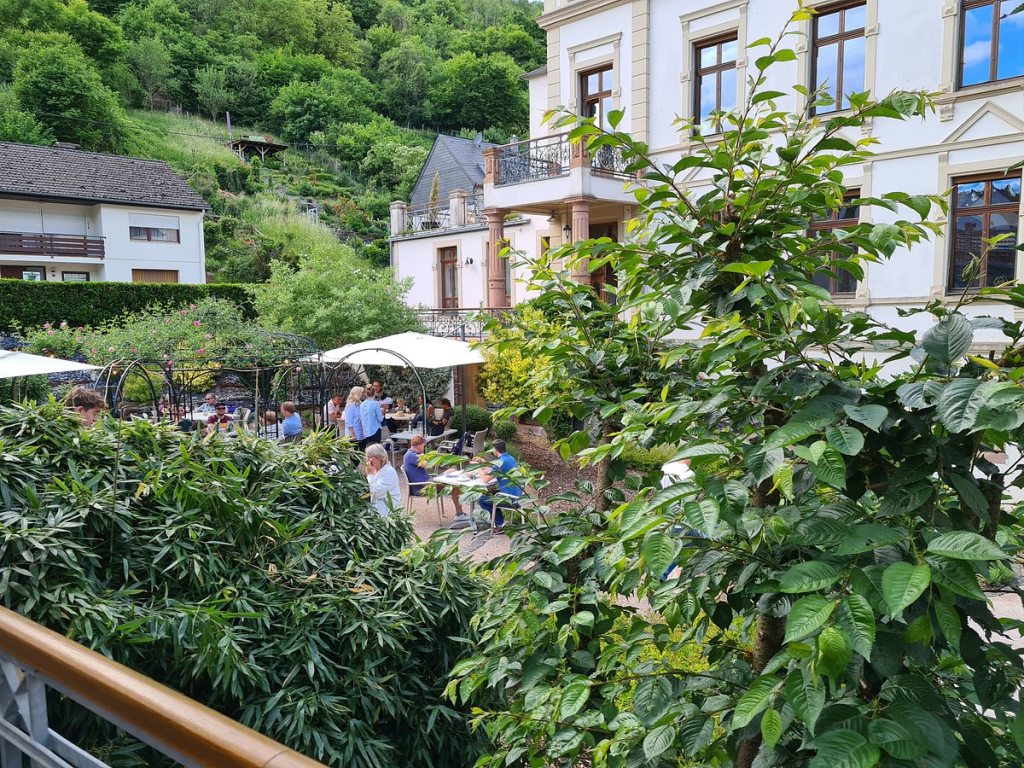
- Romantik Jugendstilhotel Bellevue (An der Mosel 11) – the obvious choice if you want to sleep in Art Nouveau style, right on the riverfront. Restaurant Belle Epoque, a spa with pool and sauna, and suites in the Palais Kayser annexe.
- Weingut C.A. Haussmann – four apartments in an 1896 Art Nouveau villa next to the wine estate in Trarbach, with a large garden and tastings on site. More on the idea in our guide to staying at a winery on the Moselle.
- Camping Rissbach – a family campsite right on the river, about 2 km from the centre along the cycle path, with a heated outdoor pool and wine barrels to sleep in. See our round-up of Moselle campsites; motorhomes have an aire (Stellplatz) at Rissbach – more in our guide to the Moselle by motorhome.
- Kröv – a quieter and often cheaper alternative, with plenty of wine estates and guesthouses. Kröv Tourist-Information has a searchable list of hosts on kroev.de.
Ask your accommodation about the Mollie Guestcard. Overnight guests in the region receive it, and it gives discounts on things like the cellar tours, the Art Nouveau walk and the Mittelmosel-Museum – plus free entry to the underground Christmas market.
How long to stay – and when to go
A full day is enough for the Art Nouveau walk, a cellar tour and the view from the Grevenburg. With two days you’ll also have time for Kröv and a wagon ride, a boat or bike trip to Bernkastel-Kues and the Buddha Museum. Traben-Trarbach also works well as a base for the Middle Moselle, with Zell and the Zeller Hamm loop in one direction and Bernkastel in the other.
May–October is high season, when the boats, wagon rides and most guided tours operate. The town’s big wine festival, the Moselwein-Festival, usually takes place on the second weekend of July – see our overview of Moselle wine festivals. For festive atmosphere, the Advent weekends with the cellar market are the highlight, while January–March is quiet, with the museum and thermal baths partly closed.
Is Traben-Trarbach worth visiting?
Yes, especially if you like architecture and wine. The town has one of Germany’s most complete Art Nouveau townscapes, guided tours of 32 historic wine cellars and two ruins with views.
How do you get to Traben-Trarbach without a car?
Take the train to Bullay on the Koblenz–Trier line, then the Moselweinbahn (RB 85), which runs hourly to Traben-Trarbach. From Bernkastel-Kues you can take the boat in season (just under two hours) or the regional bus.
When is the Traben-Trarbach Christmas market in 2026?
The Mosel-Wein-Nachts-Markt is held at weekends between 20 November 2026 and 2 January 2027 in the town’s old wine cellars. Entry is around €5 for adults and covers the whole market; under-16s go free.
Is the Buddha Museum in Traben-Trarbach open?
Yes – the 2026 season runs from 31 March to 1 November, Tuesday–Sunday 10am–6pm. In previous winters the museum has closed from January to the end of March, so check the dates before travelling out of season.
What does Kröver Nacktarsch mean?
Literally “bare bottom”. It’s the name of a vineyard site in Kröv. Legend has it that some boys who’d been sampling the wine in the cellar got a spanking on their bare backsides, but the name may also come from an old Latin word for a rocky height.
How far is Traben-Trarbach from Bernkastel-Kues?
About 19 km by car and about 22 km on the cycle route through Kröv. On the scheduled boat it takes just under two hours, passing through the lock at Zeltingen.
Want to see more of the valley? Read our list of things to do in the Moselle Valley.
- Stadt Traben-Trarbach – Jugendstil – wine trade second to Bordeaux, 1904 merger, Bruno Möhring, Brückentor 1898/99, list of buildings, wine-architecture walk
- Stadt Traben-Trarbach – Unterwelt – history of the cellars, 32 cellars, tours, times and prices, 12°C
- Stadt Traben-Trarbach – Buddha Museum – 2026 season, opening hours, floor area, address
- Stadt Traben-Trarbach – Mittelmosel-Museum – Haus Böcking, 1857 fire, collections, 2026 opening hours and prices
- Stadt Traben-Trarbach – Moseltherme – opening hours, closure weeks, water temperatures, address
- Stadt Traben-Trarbach – Grevenburg – construction date, Sponheim, destruction in 1734
- Stadt Traben-Trarbach – Festung Mont Royal – Louis XIV, Vauban, 1687–1698, Entdecker-Tour
- Mosel-Wein-Nachts-Markt – 20 Nov 2026–2 Jan 2027 season, weekends, cellars, public transport
- Stadt Traben-Trarbach – Underworld Christmas Market – admission, 16th-century cellars
- Romantik Jugendstilhotel Bellevue – address, Möhring façade, restaurant, spa
- Kröv Tourist-Information – Kröver Nacktarsch, wagon rides, Heimatfieber 2027, tourist office
- Kröv – Geschichte und Ortsrundgang – 752, Dreigiebelhaus 1658, Ritter Götz 1685, the estates
- Kröv – Anreise – train via Bullay, road via Wittlich/B 50, Hahn approx. 20 km
- Wikipedia – Moselweinbahn – RB 85, hourly service, stops (supporting source)
- Gebr. Kolb Moselrundfahrten – Bernkastel timetable 2026 (PDF) – Bernkastel–Traben-Trarbach route, Zeltingen lock, season, Advent sailings
- Camping Rissbach – riverside location, approx. 2 km to the centre, outdoor pool, wine barrels
- Weingut C.A. Haussmann – apartments in an 1896 Art Nouveau villa
- Stadt Traben-Trarbach – Camping – motorhome aire at Rissbach
- Bernkastel.de – Mosel-Radweg – Bernkastel-Kues–Traben-Trarbach stage
Last updated: October 2026. Facts checked against the sources above; prices and opening hours may change.