
Bernkastel-Kues: a guide to the Middle Moselle wine town
This article contains affiliate links to GetYourGuide. If you book through them we may earn a small commission, at no extra cost to you.

Bernkastel-Kues is the most photographed wine town on the Middle Moselle: a market square lined with half-timbered houses, a ruined castle high above the river and Germany’s most famous vineyard, the Bernkasteler Doctor, right in the middle of town. Here are the best things to do in Bernkastel-Kues, where to taste the wine, how to get there without a car and when to go.
Three experiences we recommend
Vineyards, river and wine – the three things Bernkastel-Kues does best, bundled into bookable tours.
 Covered-wagon wine tasting with a picnic basket
A tractor-drawn wagon trundles up through the vineyards while you taste local wines and dip into a picnic hamper. The tour starts in neighbouring Lieser – check the meeting point and book early in high season.
Check prices & dates →
 Boat trip + covered wagon through the vineyards
The half-day option if you want both the river and the slopes: first a boat on the Moselle, then a wagon up among the vines. Starts and finishes in Bernkastel-Kues.
Check prices & dates →
Most booked
 1-hour panoramic cruise to Lieser and Mülheim
The easiest way to see Bernkastel-Kues from the water – just the right length, and simple to fit in between the market square and lunch.
Check prices & dates →
Bernkastel and Kues – two towns on opposite banks of the Moselle
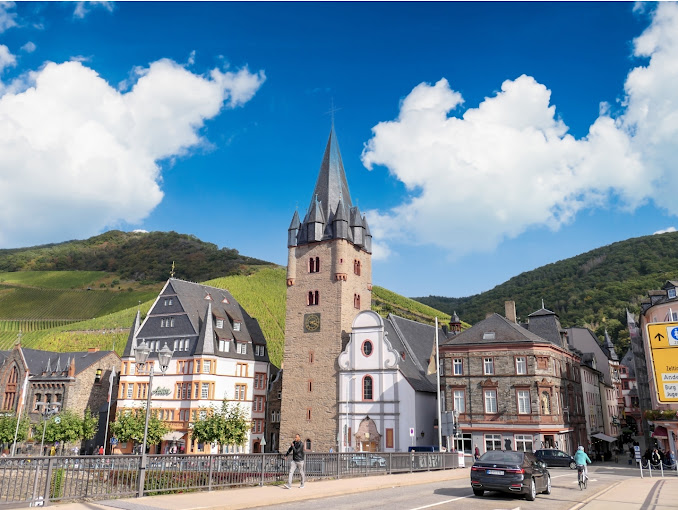
The double-barrelled name gives it away. Bernkastel, on the right bank, is the medieval core: the market square, the narrow lanes, the castle and the vineyards tumbling down to the rooftops. Kues, across the bridge, is quieter and flatter – home to the birthplace of Nicholas of Cusa, the old hospice with its wine cellar and a long riverside promenade. The bridge takes only a few minutes to walk, so expect to cross back and forth during the day.
Bernkastel-Kues sits in the heart of the Middle Moselle, roughly halfway between Trier and Cochem, which makes it a good base for a wine-focused trip along the river. To see how the towns relate to one another, take a look at our Moselle Valley map.
Things to see in Bernkastel-Kues
The Marktplatz and its half-timbered houses
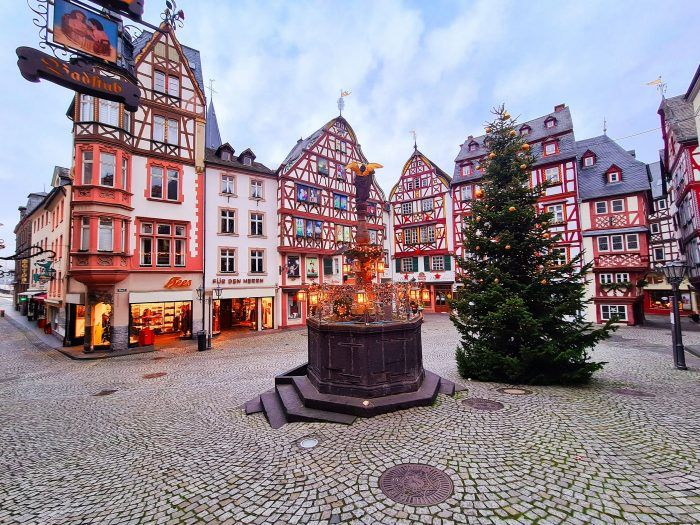
The square is why most people come. Tall, narrow half-timbered houses with jettied upper floors frame the cobbles, and in the centre stands the Michaelsbrunnen (St Michael’s Fountain) of 1606, topped by the archangel. The town hall on the square dates from 1608 and is a fine example of late German Renaissance. Come early in the morning or once the day-trippers have left in the late afternoon – around midday on a summer Saturday it gets crowded.
A few steps from the square, on narrow Karlsstraße, stands the town’s best-known building: the Spitzhäuschen (“little pointed house”), built in 1416 and, according to the tourist office, the oldest half-timbered house on the Middle Moselle. The ground floor is tiny, while the upper storey juts out over the lane so the whole house seems to balance on a matchstick. The usual explanation is that tax was once levied on the footprint of a building – so people built outwards one floor up instead.

From the square, lanes run off in every direction, packed with wine taverns, souvenir shops and small wine shops. Carry on to the Graacher Tor, the old town gate, with a statue of the archangel Michael above the arch. At dusk, when the lanterns come on in the lane inside, it is one of the loveliest views in town.

Burg Landshut – the castle ruin and the walk up
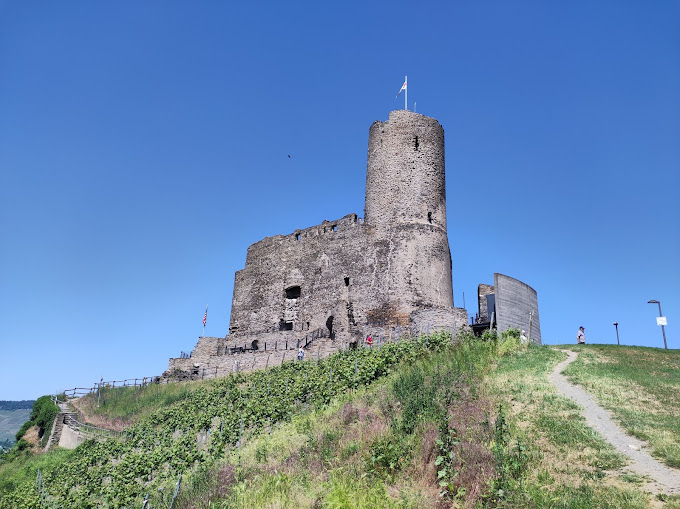
The ruin that towers over the town was built as a residence for the Archbishops of Trier. Work began after 1276 and was largely complete by around 1320. Excavations in 2012 also uncovered remains of a Roman fort from the late 4th or early 5th century, incorporated into the medieval walls. The castle survived sieges and occupations – including by Swedish and French troops in 1639 – but burned down for unknown reasons on 8 January 1692 and was abandoned for good.
You can get up on foot, drive to the car park by the castle or hop on the bright yellow Burg Landshut-Express shuttle from town. The tourist office’s circular walk around the castle hill is just under two kilometres and takes about an hour, but it is graded difficult because the climb is steep. The reward is a view straight down over the rooftops, the bridge and the bend in the Moselle. Up at the ruin there is a restaurant with a terrace serving Moselle wine by the glass.
Walk up and take the shuttle down if your knees complain. Late afternoon and early evening bring the softest light over the rooftops and the river – and fewer people on the path.
Bernkasteler Doctor – Germany’s most famous vineyard
Just above the old town lies a steep slope that wine lovers the world over recognise from the label: the Bernkasteler Doctor. The site covers only about 3.2 hectares, planted with Riesling and facing south to south-west, with gradients of up to 60 per cent. It is often described as Germany’s most expensive vineyard. The record goes back to 1900, when Julius Wegeler bought part of the hill for 100 gold marks per vine. Ownership is now split between a handful of estates, the largest being Wegeler and the two branches of the Thanisch family.
The name comes from a legend. In 1360, Archbishop Boemund II of Trier is said to have lain gravely ill with fever at Burg Landshut; when no medicine helped, he was given wine from this very slope – and recovered. The wine became his “doctor”. The story is unlikely to be true – the name only appears in written records several centuries later – but the wine has certainly graced some fine tables: Konrad Adenauer took it with him on state visits.
Doctor wines cost considerably more than everyday Moselle wine. If you want to understand the differences between vineyard sites and styles – from dry to sweet – a guided tasting is the quickest way in. Find out more about the grape in our guide to Moselle Riesling.
Kues: the Cusanusstift, the Vinothek and the birthplace of Nicholas of Cusa
Kues is the birthplace of Nicholas of Cusa (Nikolaus von Kues, or Cusanus), born in 1401 and one of the great minds of the 15th century – cardinal, philosopher and mathematician. His most important legacy in the town is the St. Nikolaus-Hospital, also known as the Cusanusstift, built in 1452–1456, with a foundation charter dated 1458. With its cloister and chapel, the building is laid out like a late-medieval monastery and is still a home for elderly residents today. The chapel is free to visit (according to the tourist office, Sunday–Friday 9am–6pm, Saturday 9am–3pm), and Cusanus’s heart is buried here, as he wished. The famous library holding his collection can only be seen on a guided tour, normally held on Tuesdays and Fridays.
In the vaulted cellars beneath the hospice is the Vinothek im Weinkulturellen Zentrum, which the tourist office describes as the world’s largest wine shop dedicated to Moselle Riesling. More than 100 wines from across the region are lined up for tasting and over 140 are on sale. It is a great place to compare villages and vineyard sites side by side before deciding which wineries to visit. The same complex also houses a wine museum.
A little further along the riverside promenade is the birthplace of Nicholas of Cusa (Nikolausufer 49), with a permanent exhibition on his life and work, open Tuesday to Saturday in the afternoons.
Opening times for the Vinothek and the hospice tours vary with the season. Check with the tourist office or ring the Vinothek (+49 6531 4141) before planning your day around a visit.
Wine experiences: covered wagons, wine taverns and tastings
Bernkastel-Kues is one of the easiest places on the Moselle to go wine tasting without much forward planning. The tourist office lists around 40 wine shops and tasting rooms in the area, from the big regional Vinothek to growers’ own tasting rooms. A few ways in:
- A wine tavern in the old town – order a “Weinprobe” of three to six small glasses and compare dry (trocken), off-dry (feinherb) and sweet.
- A tasting at a winery – more personal, often with the winemaker. Ring or book ahead, especially outside the main season.
- A covered-wagon ride through the vineyards – a tractor-drawn covered wagon (Planwagen) climbs the slopes while you taste. The most popular version locally comes with a picnic basket and often sells out at weekends.
Weinfest der Mittelmosel – the September wine festival
Every year, for five days around the first Sunday in September, the Weinfest der Mittelmosel (Middle Moselle Wine Festival) fills Bernkastel-Kues with wine stalls, music and crowds. The 2026 festival has already taken place; the next one runs from 2 to 6 September 2027. At its heart is the “Weinstraße”, a 300-metre row of wine stalls along the riverfront, and the programme usually follows the same pattern:
- Thursday: opening evening with people in traditional dress on the Marktplatz and tastings along the Weinstraße.
- Friday: crowning of the town’s wine queen, Mosella, on the Marktplatz, joined by wine queens from other Moselle villages.
- Saturday at 9pm: fireworks over the river – best seen from the Kues bank.
- Sunday from 2pm: a parade through the old town and across the bridge to Kues.
Accommodation is hard to come by during festival week, so book well in advance. For more festivals along the river, see our overview of Moselle wine festivals.
Bernkastel-Kues Christmas market 2026
The Bernkastel Christmas market is one of the most atmospheric on the Moselle. In 2026 it runs from 20 November to 20 December (closed Sunday 22 November), 11am–7pm, until 9pm on Fridays and Saturdays. Its 38 stalls are spread through the medieval centre, selling mulled wine, Riesling mulled wine, food and crafts.
- The Advent calendar: a half-timbered house on the Marktplatz becomes the region’s largest Advent calendar – a window opens every evening at 5.30pm from 1 to 23 December, and at 11am on 24 December.
- Torchlight swim on Saturday 5 December: more than a hundred divers swim through the Moselle carrying torches, accompanied by St Nicholas on a boat.
- Fireworks on Saturday 19 December along the riverfront.
- Winter boat trips: on Saturdays during the market there are hour-long round trips from Bernkastel, plus Advent cruises to Traben-Trarbach.
Combine it with Traben-Trarbach, whose own Christmas market is held in old underground wine cellars. Avoid Saturday evenings if you don’t like crowds – a weekday afternoon timed for the Advent calendar at 5.30pm is often the nicest.
Boat trips from Bernkastel-Kues
Boats moor on the riverfront in Bernkastel, near the bridge. The local operator Gebrüder Kolb runs, among others:
- A 1-hour round trip via Lieser and Mülheim, daily from Easter to the end of October (approx. €14 per adult in 2026).
- Bernkastel–Traben-Trarbach, approx. 2 hours one way, through a lock and with stops including Graach, Zeltingen and Kröv, daily May–October.
- Longer scheduled trips to Alf and Leiwen on certain days of the week, plus evening cruises with music on summer Saturdays.
A neat plan is to take the boat to Traben-Trarbach and come back by bus or bike. If you are thinking about a longer trip on the river, read our guide to a Moselle river cruise.
Cycling the Moselle Cycle Route from Bernkastel-Kues
The Mosel-Radweg (Moselle Cycle Route) runs for 248 km from Perl on the French border to the Deutsches Eck in Koblenz. It was awarded four stars by the German cyclists’ federation ADFC in 2024 and is almost entirely flat, as it follows the river. Bernkastel-Kues is the end point of two of the most popular stages: Piesport–Bernkastel-Kues (18.3 km) and Bernkastel-Kues–Traben-Trarbach (22.3 km), both graded easy. Bikes and e-bikes can be hired locally, and some hotels – Hotel Moselauen, for example – have their own rental. See more stretches in our guide to the Moselle cycle route.
Day trips: Graach, Wehlen, Zeltingen and Traben-Trarbach
Downstream from Bernkastel, some of the Moselle’s best-known wine villages are strung out like beads on a necklace – perfect for a day by bike or boat.
- Graach – the first village downstream, where the steep Riesling slopes carry on almost unbroken from Bernkastel. Good for a short walk or bike ride.
- Wehlen – on the opposite bank, known for the Wehlener Sonnenuhr vineyard and the sundial standing among its vines.
- Zeltingen-Rachtig – where the Hochmoselbrücke (High Moselle Bridge) spans the valley towards Ürzig: 1.7 km long, up to 158 metres high and opened in 2019. Controversial, but impressive seen from the river.
- Kröv – a popular wine village on the way to Traben-Trarbach, with covered-wagon rides through the vineyards.
- Traben-Trarbach – a handsome Art Nouveau town with elegant riverside architecture, approx. 22 km from Bernkastel-Kues along the cycle route.
With more time, Zell and Cochem lie further downstream, and Trier is less than an hour away by car. For more ideas, see our list of things to do in the Moselle Valley.
The covered-wagon ride in Kröv at the Bernd Hermes winery is rated 4.9 on GetYourGuide with 100+ reviews – a good alternative if the Bernkastel tours are fully booked. See the Kröv wagon ride →
How to get to Bernkastel-Kues
By air: Frankfurt-Hahn airport in the Hunsrück hills is just 35 km away and is served mainly by low-cost airlines. Frankfurt Main and Luxembourg airports have far more connections but are further away; from either, a hire car or the train to Wittlich (via Koblenz from Frankfurt, via Trier from Luxembourg) is the most convenient option.
By train + bus: Bernkastel-Kues has no railway station of its own. The nearest is Wittlich Hbf (14 km) on the Koblenz–Trier line, from where regional buses run to Kues and Bernkastel. Alternatives are Traben-Trarbach (23 km) and Trier Hbf (44 km). Check current departures in the Deutsche Bahn journey planner or with the regional transport association VRT.
By car and motorhome: the town lies on the B 53 federal road along the Moselle. Car parks by the river charge a fee, and you can buy parking tickets online in advance. Travelling by motorhome? Read our guide to touring the Moselle by motorhome.
By river cruise: if you are arriving on a Moselle river cruise, check your itinerary for the mooring point and how much time ashore you have – the market square, the Spitzhäuschen and a quick tasting fit comfortably into a couple of hours.
If you stay at a participating accommodation, you get a VRT-GästeTicket giving free travel on buses and trains in the region during your stay – ask when you book.
Where to stay in Bernkastel-Kues
Most accommodation is in family-run hotels, guesthouses and wineries with rooms. Three addresses that are still open and make an easy base:
- Hotel-Restaurant Doctor Weinstube (Hebegasse 5, Bernkastel) – right in the old town, in a house built in 1668 as a tithe house for the Elector of Trier, which became a wine tavern in 1830. 25 double and 3 single rooms, restaurant, wine tastings and sauna.
- Hotel Moselauen (Saarallee 5) – a more modern hotel with superior rooms, family rooms, accessible rooms and wellness suites, plus its own bike hire.
- Café Rosi (Nikolausufer 26, Kues) – a small family-run hotel and restaurant on the riverside promenade with a terrace looking across to Burg Landshut; a handful of rooms and two holiday flats.

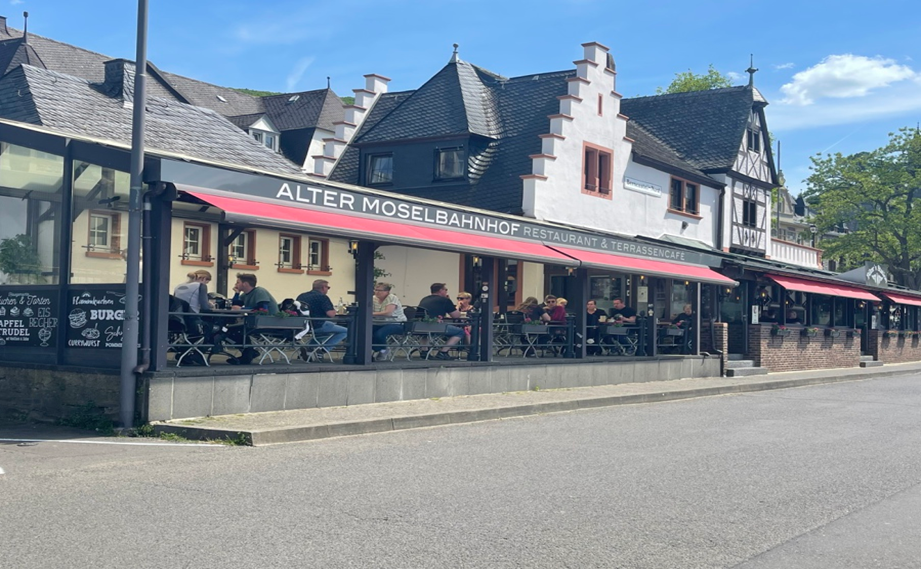
If you would rather sleep among the vines, read our guide to staying at a winery on the Moselle, or browse campsites along the Moselle. For a relaxed dinner by the water, the Alter Moselbahnhof (Gestade 19) is a safe bet: a restaurant and terrace café in the old station of the Moselle railway between Trier and Bullay, with outdoor seating right on the river.
When is the best time to visit Bernkastel-Kues?
- May–June: green vineyards, boats running and quieter than high summer.
- July–August: warm and lively, but the old town gets crowded in the afternoons.
- September–October: wine festival, grape harvest and autumn colours – for many, the best time of all. Book early.
- Late November–December: the Christmas market. Cold, but full of atmosphere.
- January–March: very quiet; many boats and some restaurants take a seasonal break.
One day is enough for the square, the castle and a tasting; two or three days leave time for a boat trip, a bike ride and a winery or two. For the weather month by month, see our guide to the best time to visit the Moselle and our page on Moselle Valley weather.
Bernkastel-Kues FAQs
Can you get to Bernkastel-Kues by train?
Not all the way. Take the train to Wittlich Hbf (14 km away) on the Koblenz–Trier line and continue by regional bus to Kues or Bernkastel. Check connections in the Deutsche Bahn or VRT journey planner.
When is the Bernkastel-Kues wine festival in 2027?
The Weinfest der Mittelmosel takes place from 2 to 6 September 2027. It always runs for five days around the first Sunday in September, with fireworks on the Saturday and a parade on the Sunday.
When is the Bernkastel-Kues Christmas market 2026?
From 20 November to 20 December 2026 (closed 22 November), 11am–7pm and until 9pm on Fridays and Saturdays. In December the Advent calendar on the Marktplatz opens a window every evening at 5.30pm.
Can you visit the Bernkasteler Doctor vineyard?
The slope rises directly above the old town and is clearly visible from Bernkastel and from the bridge. The easiest way to taste the wine is at the owners’ wine taverns and tasting rooms in town, or on a guided wine tasting in Bernkastel-Kues.
How long does it take to walk up to Burg Landshut?
The circular walk around the castle hill is just under 2 km and takes about an hour according to the tourist office, but it is steep. If you would rather not walk, take the Burg Landshut-Express shuttle or drive to the car park by the castle.
- bernkastel.de – Burg Landshut – castle history, Roman fort (2012), 1692 fire, circular walk and shuttle
- bernkastel.de – Weinfest der Mittelmosel – dates 2–6 September 2027 and programme
- bernkastel.de – Weihnachtsmarkt – dates, opening hours and events 2026
- bernkastel.de – Cusanus and St. Nikolaus-Hospital – dates, chapel, library and guided tours
- bernkastel.de – Cusanus-Geburtshaus – address, exhibition and opening hours
- bernkastel.de – Vinotheken – Vinothek im Weinkulturellen Zentrum, number of wines
- bernkastel.de – Anreise – distances to stations and airport, B 53, VRT-GästeTicket
- bernkastel.de – Moselschifffahrt – boat routes, seasons and 2026 fares
- bernkastel.de – Mosel-Radweg – length, stages and ADFC rating
- en.bernkastel.de – Historic market square – Spitzhäuschen (1416), Michaelsbrunnen (1606), town hall (1608)
- web.de/dpa – Die Weine des Bernkasteler Doctors – area, gradient, owners, the 1900 purchase and the legend
- Wikipedia – High Moselle Bridge – length, height and opening (supporting source)
- Doctor Weinstube, Hotel Moselauen, Café Rosi and Alter Moselbahnhof – addresses, rooms and history
Last updated: October 2026. Facts checked against the sources above; prices and opening hours may change.