
Saarburg: waterfall, castle and Saar Riesling near Trier
This article contains affiliate links to GetYourGuide. If you book through them we may earn a small commission, at no extra cost to you.
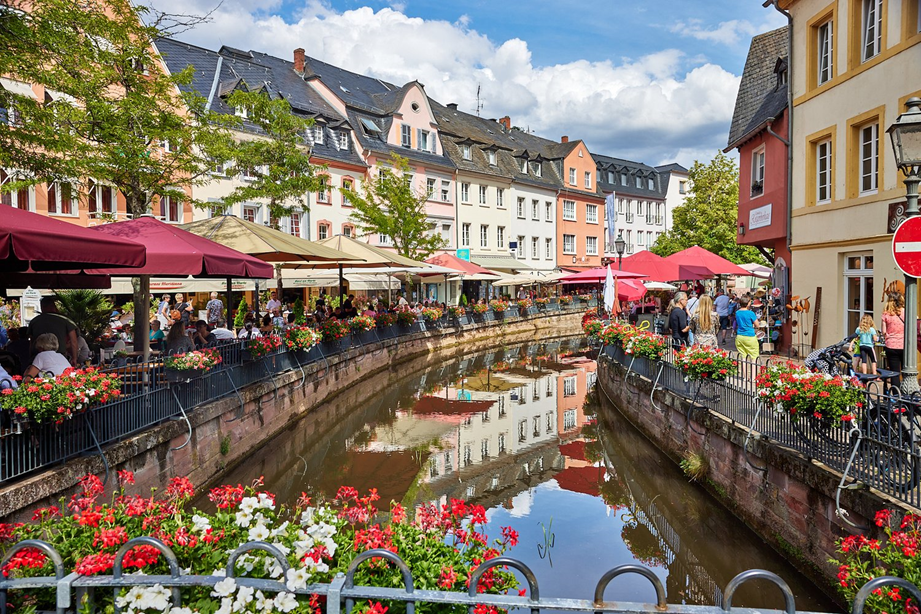
Saarburg is the perfect day trip from Trier: a small German town on the River Saar where a stream plunges almost 20 metres straight down in the middle of the old town, a 10th-century castle ruin watches over the rooftops and the steep slopes produce some of Germany’s most elegant Riesling. This guide covers the best things to do in Saarburg, how to get there by train, boat or car from Trier or Luxembourg, and how to stretch the day to the Saar Loop.
Three experiences we recommend
The boat is the most comfortable way to do the trip to Saarburg – and back in Trier you can carry on with the wines of the Saar and the Moselle.
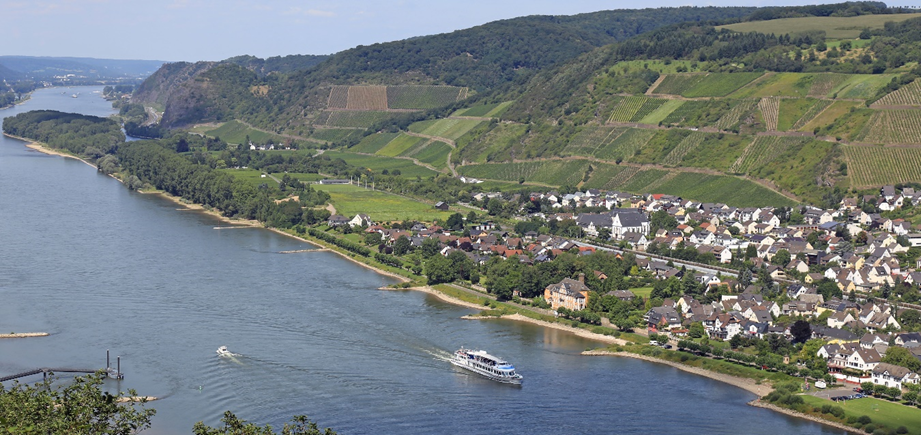 Trier–Saarburg–Trier boat trip with time ashore
Up the Moselle and onto the Saar, time ashore in Saarburg and then back to Trier – no need to think about trains or parking.
Check prices & dates →
Top rated
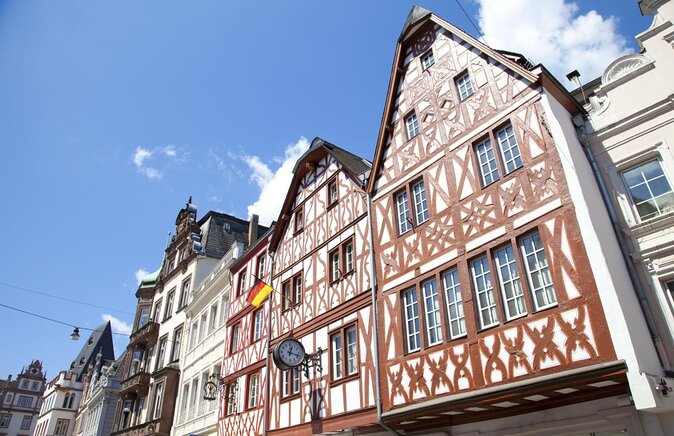 Trier walking tour with wine tasting
Roman history and wines from the Moselle and the Saar on the same walk – a great evening in Trier after a day in the Saar valley.
Check prices & dates →
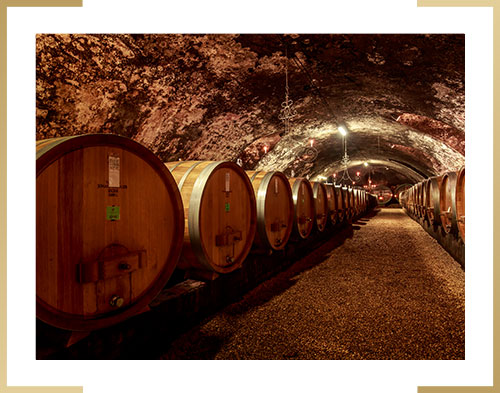 Wine hike with cellar visit in Trier
Up into the vineyards above Trier and down into a cellar – for anyone who wants to understand why the slopes along the Moselle and the Saar make such distinctive wines.
Check prices & dates →
Saarburg: a day trip from Trier on the River Saar
Saarburg isn’t on the Moselle but on the Saar, one of the Moselle’s tributaries. The Saar flows into the Moselle at Konz, just upstream of Trier, and from there it’s about 20 kilometres south to Saarburg. In wine terms, though, the town belongs to the same family: the Saar is part of the Mosel wine region, and bottles from the Saar are sold as Mosel wine.
The town is small, which is exactly why it works so well as a day out. You can see the old town on foot in a couple of hours and spend the rest of the day on the castle, the chairlift up to the Warsberg or a wine tasting. To see where Saarburg sits in relation to the rest of the valley, have a look at our Moselle Valley map.

Things to do in Saarburg
The waterfall in the old town
Saarburg’s signature sight is the waterfall in the heart of town, where the Leukbach stream tumbles down between the upper and lower town. The town itself puts the height at almost 20 metres; Trier’s tourist office says 18 metres. The falls aren’t natural: back in the Middle Ages the Leukbach was diverted through the town to drive mills, and that’s how the waterfall came about. Since 1900 the water has also generated electricity – first with a wooden waterwheel that lit up the Buttermarkt, then from 1936 with a Francis turbine that still produces power today.
Above the falls lies the Buttermarkt, sometimes called Saarburg’s “Little Venice”. From the Auf dem Graben bridge you can see the little footbridges over the stream and the rows of houses that have stood on sturdy oak piles along the water for centuries. This is where you’ll find most of the cafés and terraces.
The mills by the falls: Amüseum and Mühlenmuseum
At the foot of the waterfall stand two old mills: the Hackenberger Mühle and the former Electoral mill, dating from 1657. The mill buildings now house two small museums:
- Amüseum – the town museum, covering Saarburg’s old trades (tanners, shoemakers, apothecaries, bell founders and boatmen), with a gallery for temporary exhibitions and the hydroelectric plant. Open daily except Saturday, 11am–4pm; admission approx. €3 for adults.
- Mühlenmuseum – three mills in a row whose wheels still turn below the falls. The mill ground flour until 1974, and in the basement you can see the gearwheels and the leather belt that drove the millstone. Open May–October, Tuesday–Sunday 2pm–5pm; admission approx. €2.
The castle ruin – one of the oldest hilltop castles in south-west Germany
The castle that gave the town its name is first mentioned in a deed from 964, when Count Siegfried of Luxembourg was granted the right to build a castle on the hill above the Saar. It later became one of the favourite residences of the Archbishops of Trier. From the mid-18th century it fell into decay, and in 1860 the town bought the ruin. Large sections of the curtain wall and a residential tower still stand, and from the tower and the viewing terraces you look out over the Saar valley, the old town and the Beurig district across the river.
The way up climbs steep lanes and steps from the lower quarter of Staden, past the Protestant church of 1893. It’s a short walk, but a steep one.
Staden – the fishermen’s and boatmen’s quarter
From the foot of the waterfall, the street called Staden runs along the Saar. Together with the castle it’s the oldest part of town, shaped by fishermen and boatmen over several centuries. Look out for the old trade symbols above the doorways. Down by the water stands the Kautenturm, a medieval tower that closed off the town wall on the river side and served as a toll tower and icebreaker.
Mabilon bell foundry
At the far end of Staden lies one of Germany’s most unusual industrial heritage sites. Urbanus Mabilon founded the bell foundry in 1770, and his family cast church bells here for more than 230 years – right up to the end of 2002. The foundry has been preserved as it was and is now a museum, the Kulturgießerei Saarburg (Staden 130). You’ll see the original casting hall and objects from the 18th century onwards, and on certain dates there are bronze-casting demonstrations in the hall. The carillon in the town hall on the Fruchtmarkt came from the same foundry.
The museum is open Monday to Friday 9am–5pm and on Sundays and public holidays 11am–5pm. It’s closed on Saturdays, although groups can book tours on that day. Current admission prices are on the museum’s website.
Do it as a loop: start at the Buttermarkt and the waterfall, walk down Staden to the bell foundry and take the steps up to the castle. On the way back you pass the Fruchtmarkt, where there’s a water basin for cooling your feet on a hot day.
The chairlift and summer toboggan run on the Warsberg
The Saarburger Sesselbahn is a double chairlift built by Doppelmayr in 1976. It runs 700 metres from the valley station in town up to the Warsberg, climbing 168 metres along the way. The ride takes around ten minutes through a small conifer wood and along the vineyards – the view over the Saar valley is half the point.
Right next to the top station is the summer toboggan run (Saar-Rodel). The track is roughly 530 metres long with plenty of bends, and you control your speed with a brake lever. Children aged three and over can ride with an adult, and from eight on their own. A single run costs approx. €3, payable in cash. From the top station you can also walk back down on the Panoramaweg, a walk of about 45 minutes that ends at a viewing platform above the town centre.
| Chairlift | Toboggan run | |
|---|---|---|
| Season | One week before Easter – 31 October | One week before Easter – 31 October |
| Opening hours | Tue–Sun 10am–5.45pm (daily from mid-July to the end of August) | Tue–Sun 11am–6pm (Mondays too from mid-July to the end of August) |
| Adult fare | Approx. €5 single, €8 return | Approx. €3 per run (cash) |
| Child fare | Approx. €3 single, €5 return (ages 4–14) | Children aged 3–7 ride with an adult |
Both attractions are closed on Mondays for most of the season (public holidays excepted), and the weather can change the timetable. From November to Easter they don’t run at all. Check times and prices on the operators’ websites before you go.
Saar Riesling: wine, vineyards and wine tasting
The Saar has a cooler climate than much of the Moselle. The grapes ripen slowly, sometimes into November, and keep a lot of acidity. The result is often pale, taut, mineral wines with low alcohol – rarely above 12 per cent – that can age for a long time. Around 800 hectares are planted along the lower Saar, almost entirely with Riesling, and some slopes have gradients of up to 55 degrees. Well-known vineyards near Saarburg include Saarburger Rausch, Ockfener Bockstein and, a little downstream, Wiltingen’s Scharzhofberg.
In Saarburg itself you’ll find, among others, Weingut Forstmeister Geltz Zilliken (Heckingstraße 20), where a tasting of eight wines costs approx. €25 per person – book your visit in advance. If you’d like to see the vineyards from the inside, a wine trail (Weinlehrpfad) winds through the vines on the Warsberg.
Saarweinfest 2027 and SaarRieslingSommer
The Saarweinfest takes place on the first weekend of September, with wine stalls, live music and a parade through the old town – the next one is on 4–6 September 2027, according to the organisers. The weekend before, SaarRieslingSommer usually takes place, when around ten wine estates along the Saar open their cellars and tasting rooms (tickets in advance; in 2026 it was held on 29–30 August). The Saarburger Markttage are usually held on the first weekend of July. You’ll find all the valley’s wine festivals in our guide to Moselle wine festivals 2027.
How to get to Saarburg from Trier or Luxembourg
By train
Saarburg has a station on the Saar line between Trier and Saarbrücken. The regional trains RE 1 and RB 71 both stop there, each normally running once an hour, and extra trains run between Trier and Saarburg during the weekday rush hours. It’s only just over 20 kilometres, so the journey is short – check exact journey times and departures in the DB Navigator app. The station is in the Beurig district on the other side of the Saar; just walk across the bridge into the old town.
By boat
The most relaxing option is the boat from Trier. Trier’s boat operators run half-day trips to Saarburg: the boat heads up the Moselle, turns onto the Saar at Konz and moors in Saarburg, where you have time ashore before it turns back. The whole trip takes about six hours. You’ll find more boat trips in the valley in our guide to a Moselle river cruise.
By car or motorhome
From Trier, drive via Konz on the B51 federal road, which follows the Saar; from Saarbrücken you can take the B51 or the B419. There’s parking (with an EV charging point) at the station in Beurig, and the summer toboggan run has its own spaces for cars and coaches. If you’re touring in a motorhome in the Moselle Valley, Saarburg makes an easy detour between the Moselle and Saarland.
From Luxembourg or by air
Saarburg works well as a day trip from Luxembourg too. With a hire car it’s the easiest option; on public transport you’ll usually travel via Trier and change onto the Saar line there. If you’re flying in, the town itself points to Luxembourg, Saarbrücken and Frankfurt-Hahn as the airports to use – Luxembourg is the most practical choice for many UK and international visitors, combined with a base in Trier.
By bike: the Saar cycle path
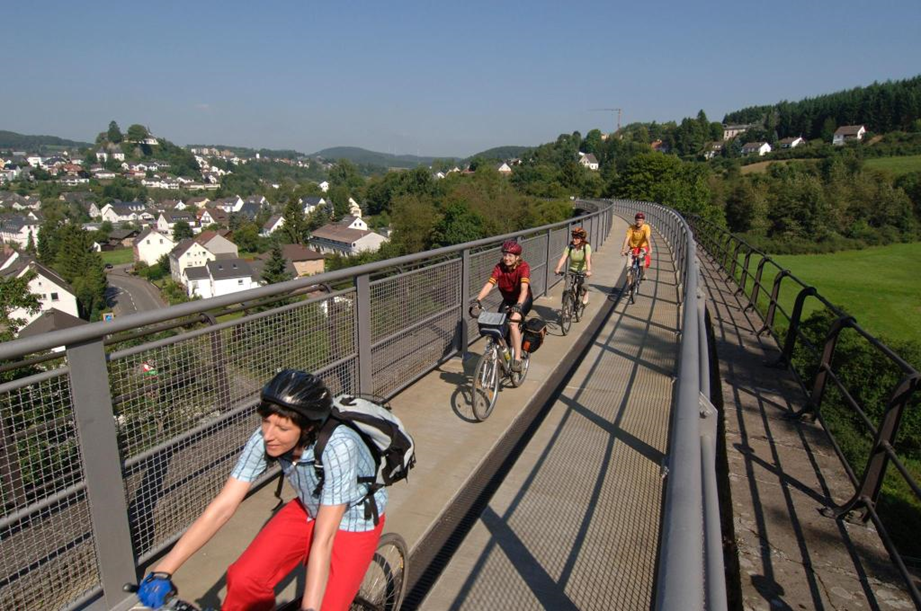
The Saar-Radweg is a 111-kilometre cycle route from Sarreguemines in France via Saarbrücken, Merzig, Mettlach and Saarburg to Konz, where it meets the Moselle cycle path (Mosel-Radweg). It follows the river and is almost entirely flat. From Trier, ride along the Moselle to Konz and then up the Saar – a comfortable day’s ride, and if you’d rather not cycle back, take the train. You’ll find the whole Moselle cycle path in our guide to the Moselle cycle route.
Make a day of it: the Saar Loop at Mettlach
Upstream, in Saarland, the river makes its most famous bend, the Saarschleife or Saar Loop. At Mettlach the Saar has cut its way through hard quartzite, and instead of taking the direct route of a couple of kilometres, it makes a detour of almost ten kilometres. The classic view is from the Cloef in Orscholz, 180 metres above the river. That’s also where you’ll find the Baumwipfelpfad Saarschleife, a 1,250-metre treetop walk that ends in a 42-metre viewing tower.
From Saarburg, Saar-Personenschifffahrt runs boats to Mettlach. In high season the day trips run on Thursdays and Saturdays, and the scheduled sailings are handy if you want to cycle one way and come back by boat. With a car you can fit in the Saar Loop on the same day, but start early.
- you’re staying in Trier or Luxembourg and want a quieter half-day out of the city
- you love Riesling and want to taste the tauter Saar wines
- you’re travelling with children – the chairlift and toboggan run are always a hit
- you’re cycling the Moselle and fancy a detour
- you’re visiting between November and Easter and want to ride the chairlift or toboggan run
- you struggle with hills – the way up to the castle is steep
- you only have one day in the Moselle Valley and want to see Cochem or Bernkastel-Kues
When is the best time to visit Saarburg?
From Easter to the end of October the chairlift, the toboggan run and the boats on the Saar are running, and the mill museum opens from May. July and August are the busiest months, when the chairlift also runs on Mondays. September brings the Saarweinfest and the start of the grape harvest. In winter the old town and the bell foundry are still worth a visit, but much else is closed. For more on the seasons, read our guide to the best time to visit the Moselle.
Stay overnight or base yourself in Trier?
For most visitors the easiest option is to stay in Trier and visit Saarburg for the day – the train is quick and there’s a far bigger choice of hotels and restaurants. If you’d rather sleep among the vineyards, there are guest rooms and holiday flats along the Saar that can be booked through the regional tourist board, Saar-Obermosel, which runs a tourist information office in Saarburg (Graf-Siegfried-Straße 32). For tips on staying with a winegrower, see our guide to staying at a winery.
Saarburg FAQs
Is Saarburg on the Moselle?
No, Saarburg is on the Saar, a tributary of the Moselle. The Saar flows into the Moselle at Konz, just south of Trier, and Saarburg lies about 20 kilometres further up the Saar. Its wines still count as part of the Mosel wine region.
How do you get from Trier to Saarburg?
The easiest way is by regional train (RE 1 or RB 71) on the Trier–Saarbrücken line – the journey is short and trains are frequent. By car, drive via Konz on the B51. If you’d like to make the journey part of the experience, there’s a half-day boat trip from Trier of approx. 6 hours with time ashore in Saarburg.
Can you visit Saarburg as a day trip from Luxembourg?
Yes. With a hire car it’s straightforward; by public transport you’ll normally go via Trier and take the regional train on the Saar line from there. Allow a full day if you want to add the chairlift or a wine tasting.
How high is the waterfall in Saarburg?
The town says almost 20 metres, Trier’s tourist office 18 metres. The waterfall was created in the Middle Ages, when the Leukbach was diverted through the town to drive mills.
Is the summer toboggan run in Saarburg open all year?
No. Both the toboggan run and the chairlift have a season from one week before Easter to 31 October and are closed on Mondays, except in high summer (mid-July to the end of August) and on public holidays.
Can you see Saarburg and the Saar Loop in one day?
Yes, if you have a car and start early. The old town and the castle take a morning, after which you drive on upstream to Mettlach and the Cloef viewpoint. Without a car, you can take the boat between Saarburg and Mettlach on Thursdays and Saturdays in high season.
- Stadt Saarburg – Sehenswert – waterfall (almost 20 m, medieval origin), castle (964), Hackenberger Mühle and Electoral mill, Staden, Buttermarkt, Kautenturm, Fruchtmarkt, Mabilon 1770–2002
- Stadt Saarburg – Wasserkraft – Electoral mill 1657, electricity since 1900, Francis turbine 1936, Amüseum opening hours and price
- Stadt Saarburg – Anfahrt – Trier–Saarbrücken railway, B51/B419, parking and EV charging at the station, Luxembourg, Saarbrücken and Frankfurt-Hahn airports
- Amüseum Saarburg – exhibitions, opening hours and prices for the Amüseum and Mühlenmuseum, history of the mill (milling until 1974)
- Kulturgießerei Saarburg – Museum Glockengießerei Mabilon – founded in 1770 by Urbanus Mabilon, operating until 2002, opening hours, address
- Saarburger Sesselbahn – season, opening hours, fares (as of March 2025), technical data (1976, 700 m, 168 m climb, 10 min)
- Sommerrodelbahn Saarburg – season, opening hours, prices, age limits, cash payment
- Saar-Obermosel-Touristik – toboggan run length (530 m), Panoramaweg, Saarburg tourist information (Graf-Siegfried-Straße 32)
- Saar-Personenschifffahrt – boats Saarburg–Mettlach, day trips on Thursdays and Saturdays in high season
- Trier Tourismus und Marketing – half-day boat trips from Trier to Saarburg, waterfall 18 m
- Saarweinfest Saarburg – dates 4–6 September 2027
- SaarRieslingSommer – format and 2026 dates
- Weingut Forstmeister Geltz Zilliken – address, tasting (8 wines, €25)
- Wikipedia: Saarburg, Saarwein, Saar-Radweg, Saarschleife, Saarstrecke – supporting sources for distances, rail lines, vineyards, the cycle path and the Saar Loop
Last updated: October 2026. Facts checked against the sources above; prices and opening hours may change.