
Koblenz – a guide to the city where the Moselle meets the Rhine
This article contains affiliate links to GetYourGuide. If you book through them we may earn a small commission, at no extra cost to you.
Koblenz sits where the Moselle flows into the Rhine – and that meeting of rivers makes it the perfect place to start (or finish) a trip through the Moselle Valley. The best things to do in Koblenz? Ride a cable car across the Rhine to one of Europe’s largest fortresses, wander an old town full of church towers and wine taverns, and reach both the UNESCO-listed Upper Middle Rhine Valley and the Moselle wine villages in a short train or boat ride.
Three experiences we recommend
The cable car, the Rhine castles from the water and the old town with a guide – three ways to see why Koblenz is called the gateway to the World Heritage valley.
 Cable car to Ehrenbreitstein Fortress
Return trip across the Rhine with optional fortress entry. The classic Koblenz view over the Deutsches Eck is waiting at the top.
Check prices & dates →
Great value
Rhine castles boat tour from Koblenz
Two hours on the Rhine past castles and palaces in the World Heritage valley – an easy way to see the Middle Rhine without changing hotels.
Check prices & dates →
Top rated
 Historic tour: old town and Deutsches Eck
A guided walk through 2,000 years of city history – from the Roman fort to the imperial monument at the confluence.
Check prices & dates →
Koblenz: the city where the Moselle meets the Rhine
The name says it all. The Romans built a fort here called Castellum apud Confluentes – the fort at the confluence – and over the centuries Confluentes became Koblenz. Today it’s no sleepy wine village but a lively mid-sized city with a university, shopping streets and traffic. The historic core, though, is compact, and nearly everything you’ll want to see is within walking distance.
For anyone travelling in the Moselle Valley, Koblenz is above all a hub. Trains and boats head up the Moselle towards Winningen, Eltz Castle and Cochem, while to the south the Romantic Rhine begins, with a castle on what seems like every other hilltop. It’s also a regular port of call for Rhine and Moselle river cruises, so many visitors get their first glimpse of the city from the deck. Two days is plenty for the city itself – add a day or two if you want to explore in both directions.
Deutsches Eck: the emperor at the confluence
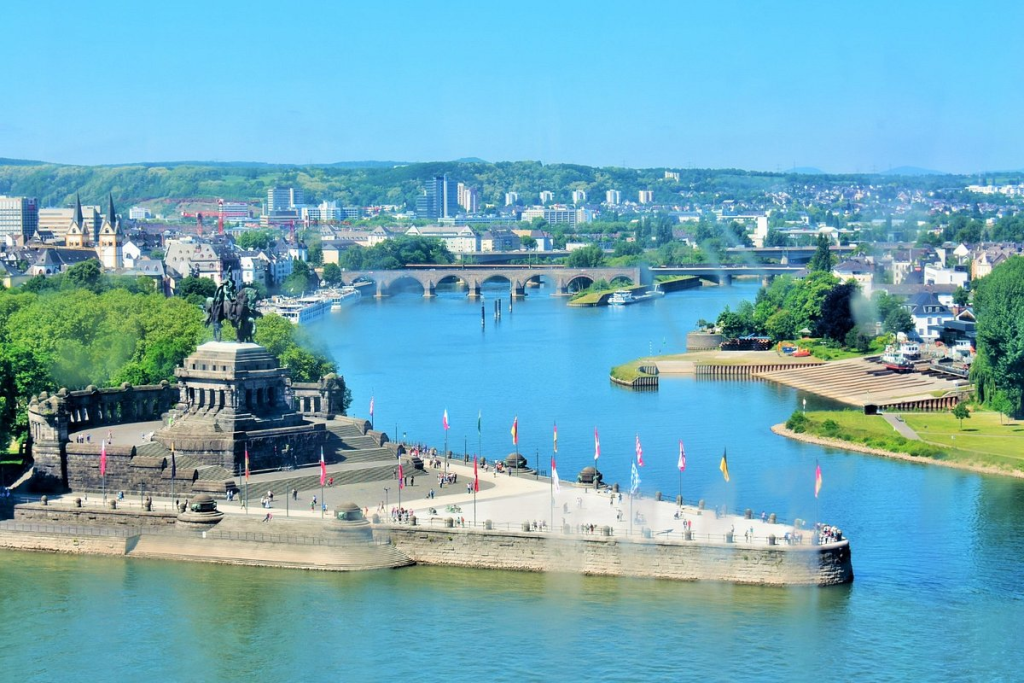
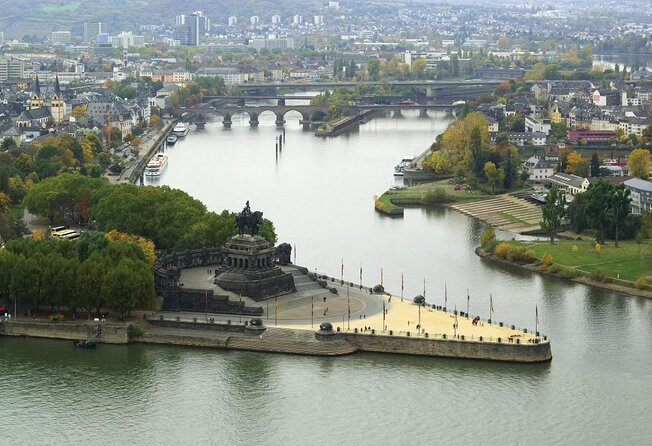
The headland where the Moselle flows into the Rhine is the most photographed spot in Koblenz. The name Deutsches Eck (“German Corner”) comes from the Teutonic Order (Deutscher Orden), which settled at the confluence in 1216. What really catches the eye today, though, is the massive Emperor William I monument: 37 metres tall in total, 14 of them taken up by the equestrian statue alone. It was unveiled on 31 August 1897.
The statue was destroyed by artillery fire in March 1945, and in 1953 Federal President Theodor Heuss turned the empty plinth into a memorial to German unity. It wasn’t until autumn 1993 that a reconstruction of the statue was hoisted back into place. According to Koblenz’s tourist board, more than two million people visit every year – come early in the morning or in the evening light if you’d like the headland more or less to yourself.
Climb up onto the monument’s plinth for views along both rivers. For the best photo of the Deutsches Eck, though, head to the other side of the Rhine – shoot it from Ehrenbreitstein Fortress, or from the cable-car gondolas on the way up.
A stone’s throw from the headland stands the Basilica of St Castor (Basilika St. Kastor), the oldest church in Koblenz. Its Carolingian predecessor was consecrated in 836, and it was here in 842 that envoys of Louis the Pious’s sons negotiated the division of the Frankish Empire, sealed the following year by the Treaty of Verdun. The Romanesque church you see today dates mostly from the 12th century.
The Koblenz cable car and Ehrenbreitstein Fortress
From the Rhine embankment at Konrad-Adenauer-Ufer, a few minutes’ walk from the Deutsches Eck, the Koblenz cable car (Seilbahn Koblenz) glides across the river to the fortress plateau on the far bank. Built for the 2011 Federal Garden Show (BUGA), it is 890 metres long and climbs 112 metres. With 18 cabins and a capacity of 7,600 passengers an hour (in both directions), the operator says it carries more people per hour than any other cable car in Germany. Cabin number 17 has a glass floor – look out for it if you fancy watching the Rhine pass right beneath your feet.
At the top is Ehrenbreitstein Fortress (Festung Ehrenbreitstein), 118 metres above the Rhine. French revolutionary troops besieged the earlier stronghold in 1797, starved it into surrender in 1799 and blew it up in 1801; the fortress you see today was built by Prussia between 1817 and 1828 and, according to Koblenz’s tourist board, is the second-largest surviving fortress in Europe. Inside the walls you’ll find the Landesmuseum Koblenz, with four exhibition buildings – covering, among other things, the state’s wine culture and its six wine regions, plus an archaeology museum – along with a fortress prison, a fortress church and plenty of ramparts to explore. Allow at least a couple of hours.
| Ticket (adult) | Approx. price 2026 |
|---|---|
| Cable car return | approx. €15.50 |
| Cable car return after 5.30pm | approx. €10 |
| Ehrenbreitstein Fortress entry | approx. €10 |
| Combined ticket cable car + fortress (1 day) | approx. €22 |
Children under 7 ride free, and dogs and bikes are allowed for a small fee. The cable car is accessible for wheelchairs and pushchairs, and a one-way trip takes just a few minutes. In 2026 the fortress exhibitions are open daily from 10am to 6pm between 29 March and 1 November; after 6pm the grounds are generally free to enter.
The cable car doesn’t run to a fixed timetable all year round. In autumn 2026, for example, it is closed from 2 to 18 November and then runs mainly in the afternoons and evenings over Advent and Christmas. Always check current times at seilbahn-koblenz.de before you go.
The alternatives to the cable car are the fortress lift (Festungsaufzug) from the Ehrenbreitstein district on the east bank of the Rhine, or a steep walk up – the fortress sits on the Rheinsteig long-distance trail.
Koblenz old town: squares, church towers and the Schängel fountain
The Altstadt is small enough to stroll through in a morning, but rich enough to make you want to linger. Take your time between the little squares – Münzplatz, one of the oldest in the city, Jesuitenplatz with its Baroque façades and the town hall, and Florinsmarkt with the Romanesque Florinskirche.
- Schängelbrunnen – in the town hall courtyard stands perhaps Koblenz’s best-loved symbol: a bronze boy who, every so often, spits an arc of water across the basin. The fountain was unveiled in 1941. “Schängel” is the nickname for a Koblenz local and comes from the French name Jean, a legacy of French rule from 1794 to 1814. Don’t stand too close.
- Vier Türme (“Four Towers”) – at the junction of Am Plan, Löhrstraße, Altengraben and Marktstraße, four corner houses sport beautifully decorated oriel windows. They were built in 1608, destroyed in 1688 and rebuilt between 1689 and 1692.
- Liebfrauenkirche – with its distinctive onion domes, the Church of Our Lady is visible across the whole old town. The little lane Kunstgässchen leads here from Münzplatz.
- Historiensäule – on Josef-Görres-Platz, a sculpted column tells Koblenz’s 2,000-year history in pictures, tier by tier.
The tourist information centre is in the modern Forum Confluentes cultural building on Zentralplatz, on the edge of the old town, and is open daily from 10am to 6pm. Pick up a map and the latest boat and cable-car times there.
Hungry? Altes Brauhaus on Braugasse, in the heart of the old town, serves hearty German food and beer in rustic surroundings. Down on the Rhine promenade is Weindorf Koblenz – four half-timbered houses built in 1925 for a national exhibition of German wine, each meant to represent one of Germany’s major wine regions. A good spot for a glass of Moselle wine; find out more about the valley’s signature grape in our guide to Riesling.
The Electoral Palace and the Rhine promenade
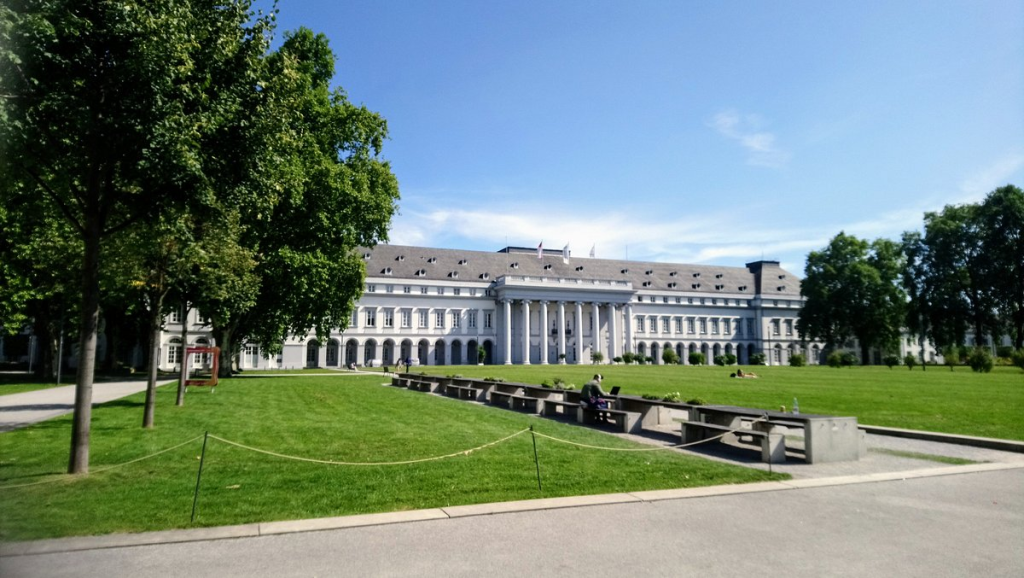
Clemens Wenceslaus, Elector of Trier, had the Electoral Palace (Kurfürstliches Schloss) built between 1777 and 1786. It is considered one of the most important palaces of early French Neoclassicism in south-west Germany, and was one of the last princely residences built in Germany before the French Revolution. It was restored for BUGA 2011, gaining a new palace garden facing the Rhine.
The palace interior can’t be visited at the moment – it is undergoing major renovation ahead of the BUGA 2029 garden show in the Middle Rhine Valley. The terraced garden on the Rhine side is free to enter, though, and from here you can follow the Rheinanlagen, the riverside gardens and promenade, one of the nicest walks in the city.
Boat trips on the Rhine and the Moselle
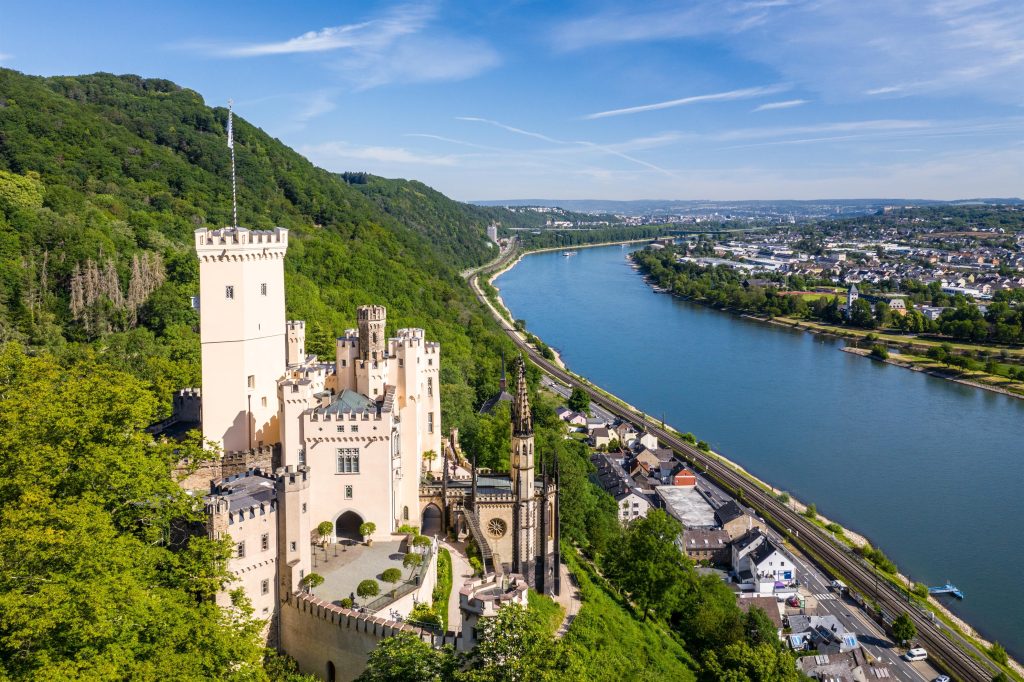
Koblenz marks the northern end of the Upper Middle Rhine Valley World Heritage Site, inscribed by UNESCO in 2002, which stretches south towards Bingen and Rüdesheim. This is the classic Rhine Gorge: steep vineyards, the Lorelei rock and a castle on almost every viewpoint. Just south of the city stands Stolzenfels Castle (Schloss Stolzenfels), which the Prussian Crown Prince Frederick William had Karl Friedrich Schinkel rebuild from a ruin from 1836 onwards; it was inaugurated in 1842. From the landing stage it’s around a 20-minute walk uphill through the park, and there’s also a bus from Koblenz.
Several operators, including KD (Köln-Düsseldorfer), run boats from Koblenz during the season. If you just want a feel for the Rhine Valley, a short round trip will do; to get as far as the Lorelei, you’ll need a full day. When water levels are low in late summer and autumn, sailings can be cancelled or cut short – check the day before.
In the other direction, the Moselle winds its way between the vine-covered slopes. There’s a panoramic Moselle cruise from Koblenz to Winningen, and if you’re staying further up the valley you can do the trip in reverse with a full-day boat trip from Alken to Koblenz and back (★ 4.6), which takes you on both the Moselle and the Rhine. Thinking about several days on the water? Read our guide to a Moselle river cruise.
Day trips from Koblenz into the Moselle Valley
Winningen – the nearest wine village
Just a short train ride up the Moselle lies Winningen, a wine village of just over 2,400 people surrounded by steep vineyard sites such as Uhlen and Röttgen. The RB 81 regional train towards Cochem and Trier stops here. In late August and early September the village holds its Moselfest, which it bills as Germany’s oldest wine festival – in 2027 it runs from 27 August to 5 September. You’ll find more celebrations along the river in our round-up of Moselle wine festivals.
Eltz Castle by train, bus or on foot
Fairy-tale Eltz Castle (Burg Eltz) sits in a wooded valley above the Moselle and is easy to visit without a car. Take the train along the Moselle to Hatzenport and change to bus 365, which runs twice an hour from 1 April to 1 November to the castle car park. The more scenic option is to get off at Moselkern and hike through the Eltz valley: the waymarked path follows the stream, and the final stretch from the Ringelsteiner Mühle is about 2.5 km. Allow a little over an hour from the station.
In 2026 the castle is open daily from 9.30am to 5pm between 29 March and 1 November, and admission (approx. €14 for adults) includes a guided tour and the treasury. In winter the castle is closed, but the trail around it stays open. It pairs well with a night in Cochem – see our guide to Cochem.
Rhein in Flammen in Koblenz
The biggest party of the summer is Rhein in Flammen (“Rhine in Flames”), a series of firework nights along the Rhine of which the Koblenz edition is the largest. It usually takes place on the second Saturday in August: in 2026 the festival ran from 7 to 9 August, with a drone show and fireworks over the Rhine on the Saturday night and Ehrenbreitstein Fortress as the backdrop. The organisers give 14 August 2027 as the provisional date for the next Koblenz event – the confirmed date and programme will be published at rhein-in-flammen.com.
Koblenz hotels fill up early for Rhein in Flammen – book several months ahead if you can. When the Rhine is low, the boat convoy may be cancelled, so keep an eye on the organisers’ news in the run-up.
How to get to Koblenz
- By air: Frankfurt and Cologne/Bonn are the most convenient airports, with plenty of flights from the UK and, in Frankfurt’s case, from North America too. Both have their own railway station with connections to Koblenz, often with one change. Luxembourg is another option if you plan to start at the upper end of the Moselle. Frankfurt-Hahn in the Hunsrück is closer, but in practice you’ll need a car or a bus from there.
- By train: Koblenz Hauptbahnhof is on the main Rhine line between Cologne and Mainz, with direct long-distance trains (IC/ICE) from many German cities, and regional trains run from here into the Moselle Valley towards Cochem and Trier. Coming from the UK without flying, you can take the Eurostar to Brussels and continue by train via Cologne. Timetables and tickets at Deutsche Bahn.
- By car: The city has around a dozen multi-storey car parks in the centre but little on-street parking. Leave the car in a car park near your hotel and walk or take the bus around town. Travelling by motorhome? See our guide to the Moselle Valley by motorhome.
The railway on the east bank of the Rhine (Troisdorf–Wiesbaden), which stops at Koblenz-Ehrenbreitstein, is fully closed for upgrading until 12 December 2026, with replacement buses. The main line via Koblenz Hauptbahnhof is not affected by this closure.
Where to stay in Koblenz
Koblenz has plenty of hotels in every price range. If you want an evening stroll along the Rhine or the old town right on your doorstep, stay in the centre; if you’re travelling by train and doing lots of day trips, somewhere near the Hauptbahnhof is practical. A few options that are open today:
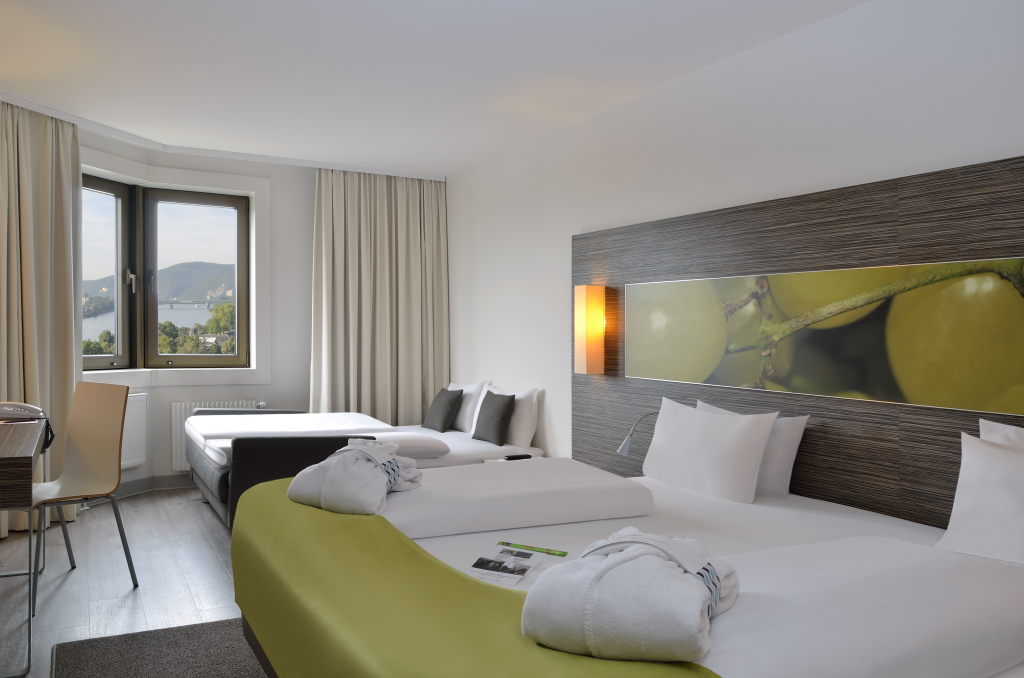
- Mercure Hotel Koblenz (Julius-Wegeler-Straße) – a large hotel near the Rhine embankment south of the palace, with river-view rooms. Good if you want the Rhine promenade on your doorstep.
- Stadthotel Brenner (Rizzastraße) – a smaller city hotel in the southern part of the centre, within walking distance of both the palace and the old town.
- Four Points Flex by Sheraton Koblenz (Neversstraße) – a modern hotel next to the Hauptbahnhof, convenient for rail travellers.
- B&B HOTEL Koblenz-City (Bardelebenstraße) – a simple budget hotel, a good-value option a little south of the centre.
Would you rather wake up among the vines? Stay in Winningen or further up the river and take the train into Koblenz for the day – there are ideas in our guide to staying at a winery on the Moselle. And if you’re still deciding when to go, read about the best time to visit the Moselle.
Koblenz FAQs
What can you see in Koblenz in one day?
Start at the Deutsches Eck and the Basilica of St Castor, take the cable car across the Rhine to Ehrenbreitstein Fortress for the views and museums, and finish with a stroll through the old town past the Schängelbrunnen, the Vier Türme and the Liebfrauenkirche. If you have time left, an evening walk along the Rhine takes you to the Electoral Palace.
Does the Koblenz cable car run in winter?
Partly. The cable car has no fixed year-round timetable: in autumn 2026, for example, it is closed from 2 to 18 November and then runs mainly in the afternoons and evenings over Advent and Christmas. Always check the current timetable at seilbahn-koblenz.de before you go.
How much do the cable car and fortress cost?
In 2026 a return trip on the cable car costs approx. €15.50 for adults, and a combined ticket including entry to Ehrenbreitstein Fortress approx. €22. Children under 7 ride free, and cheaper evening tickets are available after 5.30pm. You can also book your ticket in advance.
How do I get from Koblenz to Eltz Castle without a car?
Take the regional train along the Moselle to Hatzenport, then bus 365 to the castle (1 April–1 November, twice an hour). Or get off at Moselkern and hike through the Eltz valley – a little over an hour on foot.
When is Rhein in Flammen in Koblenz?
It usually takes place on the second Saturday in August. The organisers give 14 August 2027 as the provisional date; the confirmed programme will be published at rhein-in-flammen.com.
Is Koblenz in the Moselle Valley or the Rhine Valley?
Both. The Moselle flows into the Rhine right in the city, so Koblenz is both the northernmost town in the Moselle Valley and the northern gateway to the Upper Middle Rhine Valley World Heritage Site. Discover more places along the river in our overview of towns in the Moselle Valley.
- Seilbahn Koblenz – cable car technical data (length, height difference, cabins, capacity), prices, autumn/winter 2026 timetable, dogs/bikes, accessibility
- Generaldirektion Kulturelles Erbe – Ehrenbreitstein Fortress – 2026 opening hours and prices, combined ticket, Landesmuseum, fortress lift
- Koblenz-Touristik – Deutsches Eck – history and dimensions of the monument, visitor numbers, origin of the name, UNESCO 2002
- Koblenz-Touristik – Festung Ehrenbreitstein – height above the Rhine, French siege 1797–1799 and demolition in 1801, construction 1817–1828, size
- Koblenz-Touristik – Altstadt – squares, churches, Historiensäule, St Castor
- Koblenz-Touristik – Kurfürstliches Schloss – history, renovation until BUGA 2029
- Koblenz-Touristik – Schloss Stolzenfels – reconstruction, footpath from the landing stage
- Koblenz-Touristik – Anreise – parking, 2026 closure of the east Rhine railway
- Koblenz-Touristik – Schängel fountain and Vier Türme – dates and background
- Koblenz-Touristik – St Castor’s Basilica – consecration in 836, negotiations in 842
- Rhein in Flammen – 2026 dates and provisional 2027 date, boat convoy at low water
- Burg Eltz – season, opening hours, admission, bus 365 and trail from Moselkern
- Gemeinde Winningen – Moselfest 2027, vineyard sites, population
- KD Köln-Düsseldorfer – boat services in the Middle Rhine Valley, cancellations at low water
- Altes Brauhaus Koblenz and Weindorf Koblenz – address and history
- The hotels’ own websites (Mercure, Stadthotel Brenner, Four Points Flex, B&B HOTEL) – currently operating and address
Last updated: October 2026. Facts checked against the sources above; prices and opening hours may change.